


Reflecting on Projecting |
Read more at in70mm.com The 70mm Newsletter |
| Written by: Thomas Hauerslev, in70mm.com for caboosebooks.net's Planetary Projection | Date: 20.03.2012 |
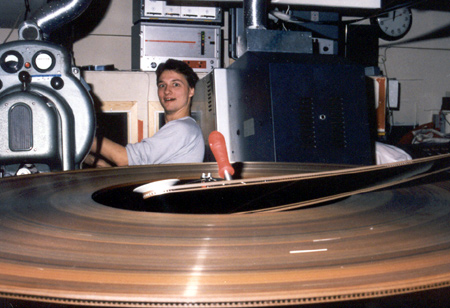 Well...me
at work as a projectionist at ABCinema in October 1986. Left is a Bauer B14 and right is a
Bauer U3 projector. 70mm print of "Out of Africa" in foreground. Image by
Stig Westergaard. Well...me
at work as a projectionist at ABCinema in October 1986. Left is a Bauer B14 and right is a
Bauer U3 projector. 70mm print of "Out of Africa" in foreground. Image by
Stig Westergaard.In early 1982, at the age of 19, I asked the manager of the ABCinema+D if I could be trained as a projectionist. He knew my interest of 70mm and instead called the manager of 3 Falke Bio, Copenhagen’s original Todd-AO theatre. When I started as a trainee projectionist (Filmoperatør) at the 975-seater “3 Falke Bio”, it was a dream come true for me. The oldest projectionist was asked to train me. He was a very odd, sarcastic and grumpy man, not caring at all about projecting, presentation or finesse, let alone a new apprentice projectionist. Very soon he also got rid of me. I didn’t mind, and I continued my training with his colleague. In those days, you had to have at least 400 hours of training before going on your own, so I kept a record of my hours at the 3 Falke. I wasn’t paid anything for being there, it was all done after school in my free time. |
More in 70mm reading: Meet the Chief - Thomas Hauerslev by Cinema Technology Thomas Hauerslev Receives BKSTS Award Internet link: Planetary Projection |
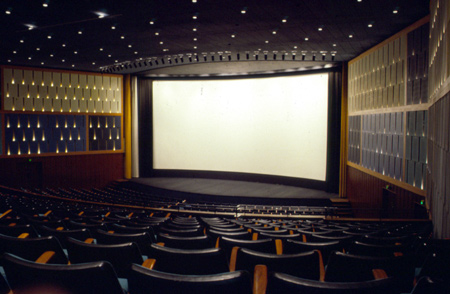 State
of the art luxury from 1958, the High-Impact cinema 3 Falke Bio, built 25
years before the concept was even devised. Image by Thomas Hauerslev State
of the art luxury from 1958, the High-Impact cinema 3 Falke Bio, built 25
years before the concept was even devised. Image by Thomas HauerslevThanks to the friendly teacher, the training was good, and rather uneventful. I do remember one evening; however, when the sweat started to build up with express speed. It happened while running a 70mm print of “My Fair Lady”. When I went to lace up R.8 into the DP70, only moments before reel 7 was coming to an end on the other machine, I discovered to my horror that I had neglected to rewind R.8, from the previous night. I could not find the countdown leader on the reel! It was tail out. My teacher stayed calm, simply turned on the light on in the cinema, and rewound the reel, laced up and then the show continued. A good lesson learned. |
|
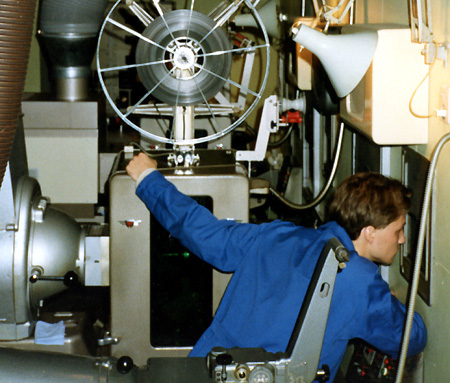 Getting
ready to show the 35mm adverts and trailers on Imperial Bio's DP70 machine #2.
Image by Bjørn Milde Getting
ready to show the 35mm adverts and trailers on Imperial Bio's DP70 machine #2.
Image by Bjørn MildeIn those days, there were two training sessions at the Danish projectionist school. One lasting 1 week, and another for 2 weeks I seem to recall. Some weeks before passing the exams and getting my certificate, I was asked to run the film alone one evening, as my trainer probably felt I could do it, and they were unable not get a replacement. I can’t remember for sure, but I think “The Godfather” was my first film alone as a “reel” projectionist. |
Dear Friends, It is amazing that in so many stories we are able to find similarities and things in common amongst people involved with film projection. When you say that with today's automation one might as well stay at home I couldn't agree more. Yesterday, for example I took the trouble to drive to a distant shopping mall, in order to see "Hugo" with subtitles (most copies in exhibition are now dubbed, for some reason). But the multiplex people, an American theater Cinemark no less, chose to project Hugo in one of their smaller rooms. Add that to a projector fitted with a low wattage lamp, and the result is, as you say in your testimony, unimpressive! My daughter went to see Hugo with me. By the time we got home I fired up my home system and loaded Pixar's "Ratatouille" on Blu-Ray, and I said to her to look at the difference in quality of both picture and sound. |
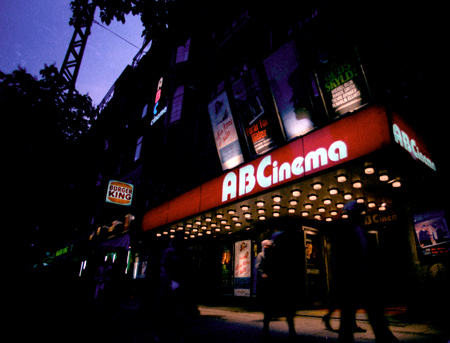 The
ABCinema (1974-1989) in all its glory. Image By THomas Hauerslev The
ABCinema (1974-1989) in all its glory. Image By THomas HauerslevA year later in November 1983, after permanent closure of the 3 Falke, I got the best job I could imagine. A full time job projecting films at the 4-plex ABCinema+D, right in the middle of the city, on town hall square. At the same time, I was also alternating with the Cinema 1-8 across the square for a day two during the week. For 6 years, I had my hands full with a lot of work, good colleagues, the audience, and a LOT of films. One favorite was “Amadeus” which we ran for 16 months. A most enjoyable film. |
In the old days you would get excellent picture from a voltaic arc lamp
house, especially off 70 mm projection and sound was always thrilling.
There is better sound today off digital soundtracks, but the
installations are, relatively, poorer. And that's the reason my home
environment is far easier to control and to calibrate, if you know what
you are doing. Consider the days when we had 16 mm projectors at home. With all the possible shortcomings digital playback now is far superior, and in no small measure due to the state-of-the-art, studio-like, soundtracks. In other words, with all the latest modifications in commercial film exhibition, the magic of showmanship was lost forever, and if no one cares I am better off seeing my movies at home. Best regards, Paulo Roberto Brazil |
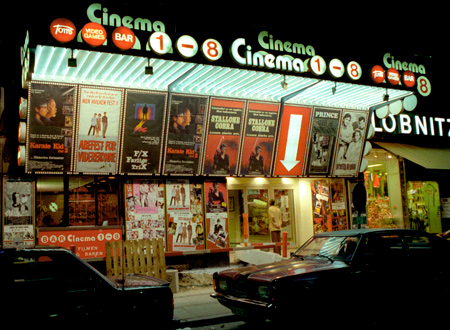 The
Cinema 1-8, with 8 small hugely popular cinemas from 1974 - around 1990.
Image by Thomas Hauerslev. The
Cinema 1-8, with 8 small hugely popular cinemas from 1974 - around 1990.
Image by Thomas Hauerslev.Reflecting back to that time of my life, I enjoyed the responsibility of the job, the environment of the “ticking” projectors, flickering light on the screen and the social aspect of entertaining the audience. I surely felt like being a part of show business (however small my part was). I spent most of my time in the cinema, often working 50-60 hours weekly. It was great fun, and I bought my own flat from the money earned in the cinema. |
|
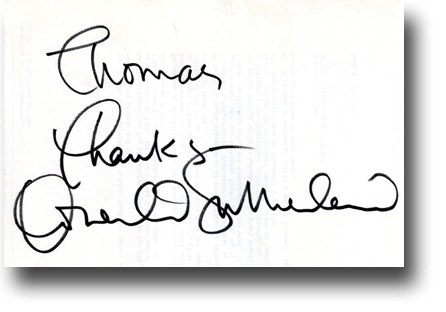 Donald
Sutherland's autograph Donald
Sutherland's autographBeing in my early 20s, I also matured enough to realize that I needed a “proper” education. I didn’t see myself projecting films for the rest of my life. Sitting in the cinema, often in box office, waiting for the last show to finish, was simply too boring. Except one evening when Donald Sutherland (the actor) suddenly showed up to see a film. He was in town filming “Oviri”. Personally projecting a film for a prominent member of the Hollywood community was quite a thrill. With the level of automation, however, projecting films was the perfect job for doing my school homework at the same time. On occasion, colleagues or friends came by for beer and a chat, when I had to do a print rehearsal of a new film after midnight. I think it was a nice way of life for me to be associated with this business and the talented people around it. To this day I have relations with some of my old colleagues who still work in the cinema business. Not everyone could cope with the loneliness of being the projectionist, however. Unfortunately I have had colleagues who had serious drinking problems and who had to leave the service. The dark side of being a projectionist, I assume. |
26.03.2012 I just wanted to say thank you for writing such a wonderful article. Your experience as a projectionist was heartfelt. Projectionists help take audiences to places they've never been before. Bill Kallay, Los Angeles, California, USA • Read Bill's full comment |
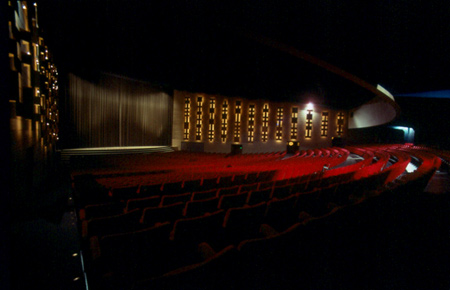 High point
of Danish cinema design, the elegant Imperial Bio from 1961 in all its
grandeur. Seen here in 1982. Image by Thomas Hauerslev High point
of Danish cinema design, the elegant Imperial Bio from 1961 in all its
grandeur. Seen here in 1982. Image by Thomas HauerslevI love to watch movies. I have always enjoyed going to the cinema, sit down, and watch the film. Follow the careers of the stars, directors and cinematographers. Oddly, this interest often took place at Copenhagen’s majestic Imperial Bio in the early 1970s, a place with 1521 seats, a curved screen, 70mm and beautiful 6-track sound. 20 years later, in 1994, my projectionist career ended at the very same Imperial Bio. I had seven good years with the DP70s at the Imperial and I felt it was a privilege to be trusted this beautiful cinema. Some of my fondest memories are meeting my future wife in the box office, having the director of “The Adventures of Priscilla, Queen of the Desert” thanking me for the best performance of his film he’d ever seen, and projecting my favorite film “Lawrence of Arabia” twelve times in 70mm on the curve. All very good Imperial memories to me. |
|
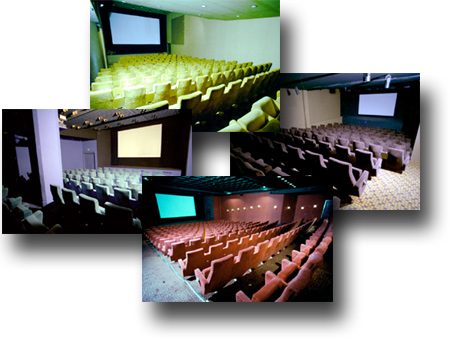 The
4 cinemas of ABCinema+D. Clockwise from the top: A, D, B and C. Images by
Thomas Hauerslev The
4 cinemas of ABCinema+D. Clockwise from the top: A, D, B and C. Images by
Thomas HauerslevMost of my time, however, I was associated with small shoe-box sized cinemas, single projector installations with non-rewind systems. Typical multiplex cinemas, and very successful too. German Bauer machines, ISCO lenses, Japanese anamorphics and mono sound was the standard where I worked. A few had Dolby Stereo, one even Dolby mono. None of the cinemas had particularly good sound. It wasn’t bad; it was just unimpressive considering the possibilities being made possible by Dolby Laboratories at the time. It simply wasn’t good enough I felt. In those days, 70mm Dolby 6-track mag was on its way up, together with optimizing sound and design of cinemas. All that seemed to bypass Danish cinemas completely – much to my own frustration. A colleague and I made a report to the management and proposed how we should upgrade all our cinemas to modern standards. We felt we could do much better presentations in High Impact cinemas with curved screens, better seating, ultimate sound systems and top of the line projection – all things necessary to keep our audience from going elsewhere with their money. I firmly believe that High Impact cinemas will always attract the audience, and any film will look spectacular in such a cinema. Our report was well received…and then forgotten. A few years later all “my” cinemas were closed instead. Another missed opportunity for the cinema business I guess. That’s ironic. |
|
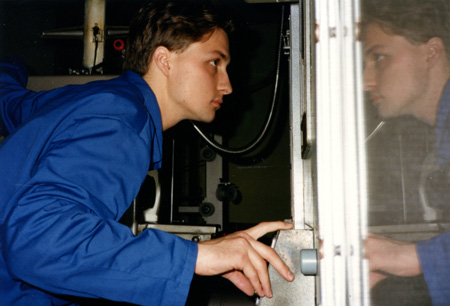 "Mr
in 70mm" concentrating on the screen at Imperial Bio. Image by Bjørn Milde "Mr
in 70mm" concentrating on the screen at Imperial Bio. Image by Bjørn MildeThe audience is the most important factor. Without them, there is no cinema, It is paramount to take care of them. As a projectionist I have had my golden moments. Like at the climax of “Fatal Attraction” cranking the volume up, at the very end when Glenn Close comes out of the bath, and the whole house is SCREAMING with fear. Just a few seconds with increased volume made a lot of difference. Or, when Timothy Dalton first appeared as James Bond, I had 1521 guests sitting, roaring and cheering. When he first kissed the girl, same thing, and during his first suave gesture, it was like the roof lifted. I had goose bumps enjoying those moments. The premiere audience is different from the regular audience. Their anticipation needs special care and I felt I did make their evening very special. Its showmanship, and that is why a projectionist is necessary. If everything is automated, you might as well stay home, and see the film on another medium. Cinema will become a fake plastic experience. |
|
 Gold
painted intermittent sprocket - "The Golden Sprocket". Gold
painted intermittent sprocket - "The Golden Sprocket". I welcome the digital projection technology with increasing resolution in 4, 8 and 16 K and full multichannel PCM sound. Finally, high quality pictures are available to everyone. Movies are available everywhere for more people than ever before. From cinemas to cell phones and from discs to internet, it’s exciting to follow the development of this wonderful and crazy medium. I decided to quit while it was still fun, and on my last day at work, some great colleagues awarded me the Golden Sprocket award for my ultimate projectionism over the years. A memorable gesture, which I appreciated a lot. A lot has changed with projection technology since I left, and I have tried to keep up with technology after I resigned, but I never showed films again – except for the odd occasion, on my Philips DP70 at home. |
|
Mini Bio | |
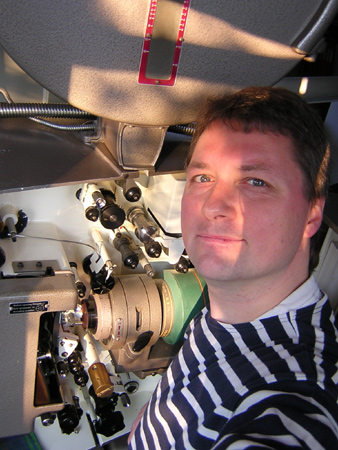 Thomas
Hauerslev, MBKS (1963) was a projectionist in Copenhagen (Denmark) between
1982 and 1994. After leaving the cinema business, he served 14 years at the
Danish State Railways, and since 2001, he has been employed by the European
Environment Agency. After leaving the cinema business, he published
The 70mm Newsletter (1994-2002),
and since 1999 he has edited in70mm.com, a
web site dedicated to large format films. He is also the editor of
biografmuseet.dk, another web site
about all Danish cinemas and related topics. He was awarded an
Honorary Membership of the BKSTS
for the work in preserving the history of 70mm and for keeping it alive in
arranging screenings. The award was presented on 14th December 2009 at the
Odeon Leicester Squere in London. He is
married to Charlotte, and they have two teenagers living at home. Thomas
Hauerslev, MBKS (1963) was a projectionist in Copenhagen (Denmark) between
1982 and 1994. After leaving the cinema business, he served 14 years at the
Danish State Railways, and since 2001, he has been employed by the European
Environment Agency. After leaving the cinema business, he published
The 70mm Newsletter (1994-2002),
and since 1999 he has edited in70mm.com, a
web site dedicated to large format films. He is also the editor of
biografmuseet.dk, another web site
about all Danish cinemas and related topics. He was awarded an
Honorary Membership of the BKSTS
for the work in preserving the history of 70mm and for keeping it alive in
arranging screenings. The award was presented on 14th December 2009 at the
Odeon Leicester Squere in London. He is
married to Charlotte, and they have two teenagers living at home. |
|
About Planetary Projection | |
|
Planetary Projection is a collaborative
on-line project that will profile individual film projectionists around the
world. Perhaps you would consider submitting a few hundred words about film
projection – something about your work you’ve always wanted to share, to
inform people about? We’d like contributions to be lively and personal, something that will interest everyone from casual web surfers to film historians. Rather than starting out by saying ‘My name is . . .’, perhaps you could take pen in hand and set down your innermost thoughts, beginning with a sentence that might start out: ‘Sometimes when I’m in the booth I think . . .’; or ‘The important thing to remember about film projection is . . .’; or ‘To me, digital projection . . .’; or ‘The strangest thing that ever happened to me in the booth . . .’; etc. Some basic information about you can be provided in a separate mini-biography accompanying your contribution. Our on-line album will gradually form and grow. A printed book is planned when enough portraits have been created. Planetary Projection is a project of caboose, an independent scholarly film book publisher whose acclaimed new English translation of selected essays from André Bazin’s anthology What is Cinema? was released in 2009. Yours sincerely, Marina Uzunova Project coordinator October 2011 Planetary Projection |
|
| Go: back - top - back issues - news index Updated 22-01-25 |