


"Ryan's Daughter" in 4k UHD Review | Read more at in70mm.com The 70mm Newsletter |
| Reviewed by: Jonathan Kleefield, M.D. | Date: 08.11.2026 |
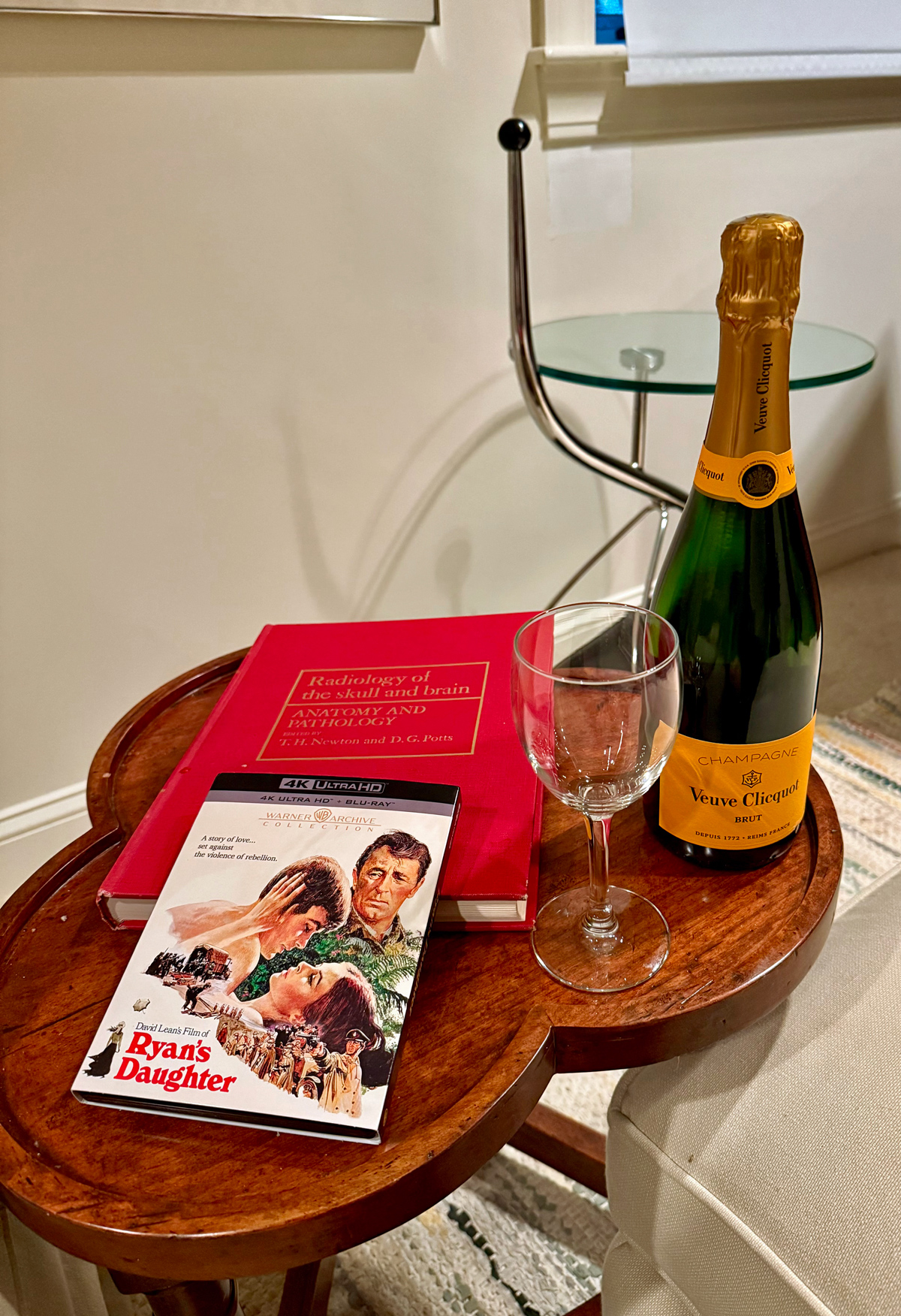 Approximately six weeks ago, while perusing the You Tube channel, I came across a notice of the upcoming 4K UHD release of a fully restored version of David Lean’s 1970 film, “Ryan’s Daughter.” The individual hosting this announcement was George Feltenstein, who is a senior official at the Warner Brothers Archive Division. He was nothing short of ecstatic at the result of the efforts of his team, emphasizing that the 65mm negative was scanned at 8K resolution, and given the digital luxury of spanning two 4K discs, accommodating very high bit rates- up to 100mb/sec. An outfit called “Fidelity in Motion” was tasked to provide the optimum transfer of this massive data stream to the discs themselves. Thus, at least technically, I was motivated to purchase the set, which also contains many bonus “extras.” I will have the ability to compare image quality with the rather ancient DVD version I had recently borrowed from our public library. On that disc, I did view the entire 3 ½ hour film and all of the extras on it, as well. The same extras have been ported over to the new version- they remain in standard definition, and have no subtitle option. The film itself has only English subtitles. Comparison with the original film presentation will be more problematic for me, as I had only seen it once, at the time of its 1970 premiere in New York City at the Ziegfeld Theatre. I do recall that the venue did not have a curved screen, which was a disappointment. The theatre has since been destroyed, although the building itself has been repurposed as an “event venue.” The film itself received extremely negative reviews at the time, wounding the director personally to such a severe degree that he withdrew from making any more movies for 14 years. In one of the extras segments, critic Richard Schickel apparently led the pack of “wolves,” who excoriated the director in person just after he came off the plane in New York City. Rather contemptuously, Schickel claims to have had no sense of responsibility for Lean’s retreat from directing. The master finally returned to the screen with a terrific adaptation of the E.M. Forster novel, “A Passage to India,” starring the late Peggy Ashcroft. Sir David passed away in 1991, and had a memorial service in his honor that year at St. Paul’s Cathedral in London. • Go to "Ryan's Daughter" coming to 4k UHD • Go to "Ryan's Daughter" Revisited The actual production of “Ryan’s Daughter,” was mired in difficulties, particularly with regard to casting. The story was an adaptation of Flaubert’s “Madame Bovary.” In the version by screenwriter Robert Bolt, a feisty Irish girl becomes enamored with and marries an older school teacher, but soon becomes restless. Into this very small town comes a young, handsome, but moody British officer, wounded in battle, and suffering from “shell shock,” but who diverts the young lady’s attention. These growing relationships are played against the British occupation of Ireland, with a rebel force arriving to stir up trouble. Playing the girl was Robert Bolt’s young wife, Sarah Miles, and the school teacher, Robert Mitchum. The British officer was portrayed by a relatively unknown actor, Christopher Jones, whom Lean hired without the usual screen test. It was reported that Jones’ appearance and acting style were quite reminiscent for Sir David of the late James Dean, and it was those characteristics, as well as his performance in a movie called “Wild in the Streets” that made him a candidate for this important film role. Lean also turned to Jones after his initial consideration for the part, Marlon Brando, became unavailable. For Sir David, it turned out to be a supposed disaster, as his efforts to mold Jones’ performance were fruitless. Moreover, Jones admitted he had none of the needed amorous “chemistry” with Miles. It’s alleged that Miles and Mitchum drugged Jones’ morning cereal to alter his behavior, already suffering from mood swings resulting from the gruesome, savage murder of his secret girlfriend, the actress Sharon Tate, by the Charles Manson gang. To compound these emotional matters, Jones was simultaneously engaged to Olivia Hussey. Lean was so dissatisfied with Jones’ performance, particularly his inability to master a British accent, that all of his lines were dubbed in post-production by another actor, Julian Holloway. After this film was finished, Jones abandoned his acting career. Watching this film now a third time, I feel Jones’ emotionally withdrawn characterization was perfect. Moreover, he probably had less than two pages of dialog in the whole movie, so the dubbing task could not have been too lengthy. To make matters worse, the gorgeous Irish Dingle peninsula was besieged by endless rain, wreaking havoc with the production schedule, and eventually forcing some of the beach scenes to be photographed in South Africa. Sir David was a perfectionist, and caused extensive production delays waiting for the best cloud formations and lighting to photograph. For the massive ocean storm, Oscar-winning cinematographer Freddie Young and second unit director Roy Stevens attached a “Clear View Screen” in front of the waterproof camera housing- essentially a rapidly spinning glass disc which, through centrifugal force, kept water droplets from obscuring the camera lens. This device had been used on boats, to allow ship’s pilots to see ahead with clarity in rough seas. The results achieved by Young and Stevens, not surprisingly, were spectacular. In fact, Young’s photography throughout is surpassingly beautiful. In those days in Britain, a cinematographer was known as a “lighting cameraman,” and scene after scene confirms the extraordinary use of illumination, both from nature, and artificially by Young, to maximize the scenic spectacle and model the actors’ faces. I have had the pleasure of reading and now owning Young’s text on cinematography, and now understand more fully his remarkable methodology. Lastly, Young had also received extensive recognition for his previous collaborations with Lean, namely "Lawrence of Arabia" and “Dr. Zhivago.” • Go to Ryan's Daughter. Exhibitor's Campaign Book From MGM • Go to gallery A visit to the School House, Dunquin, Ireland | More in 70mm reading: "Ryan's Daughter" coming to 4k UHD Ryan's Daughter. Exhibitor's Campaign Book From MGM “Ryan’s Daughter”: The North American 70mm Engagements in70mm.com News Peripheral Vision, Scopes, Dimensions and Panoramas in70mm.com's Library Presented on the big screen in 7OMM 7OMM and Cinema Across the World Now showing in 70mm in a theatre near you! 70mm Retro - Festivals and Screenings |
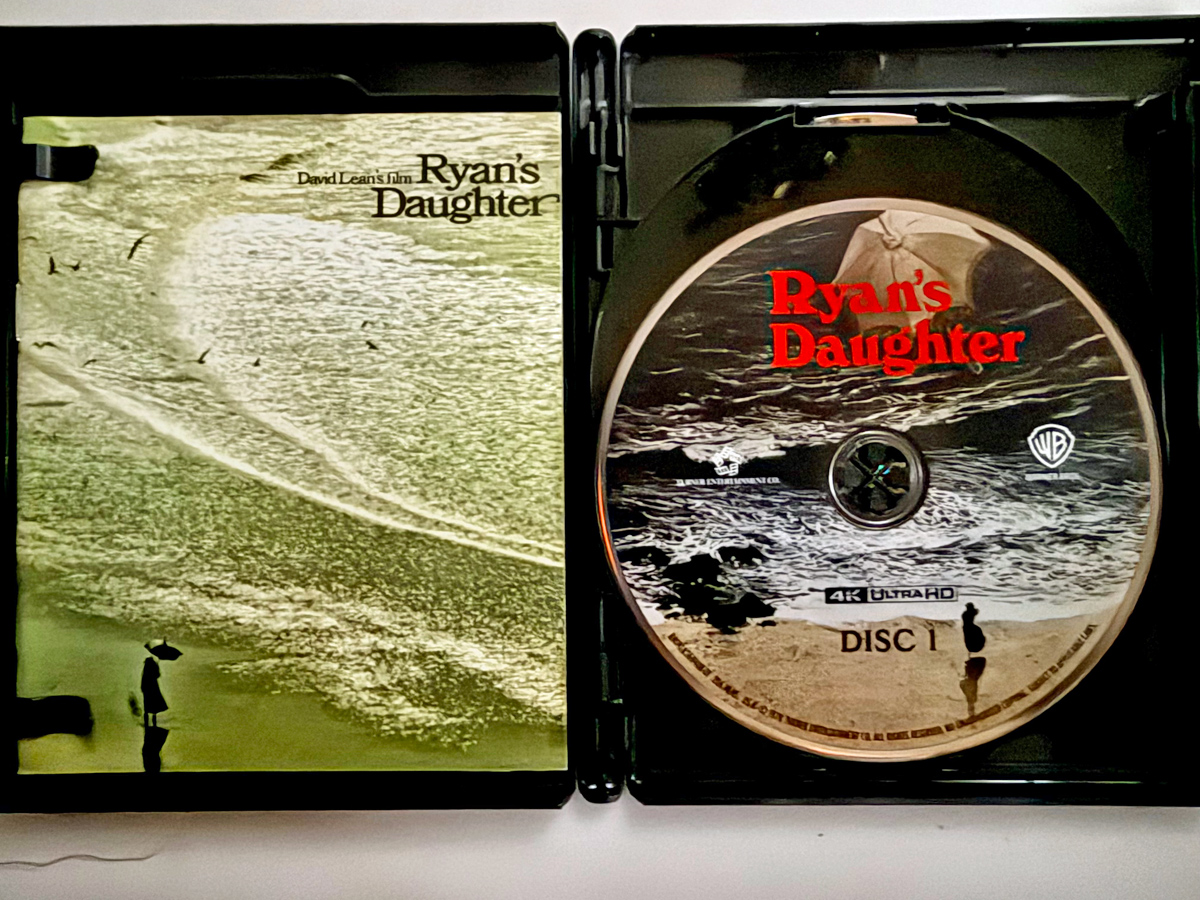 The musical score, as with the previous cited Lean films, was by Maurice Jarre. While an authority no less than Robert Harris claims this is his favorite Jarre score, I find the endless permutations of one theme (for the girl) for the 3 ½ hour film length to test my musical patience to the extreme. Only two other themes were constructed, one for the “village idiot,” which won actor John Mills a well-deserved Oscar, and British military band music. Similar thematic repetition can be found in “Zhivago,” and to a lesser extent in “Lawrence,” but somehow in those films it was less irritating. For “Lawrence,” given that Jarre was handed the assignment to compose the entire two hour plus score in only six weeks after composers William Walton, Malcolm Arnold, Aram Khatchaturian, Benjamin Britten, and even Richard Rodgers either turned down the offer or were rejected, Maurice reportedly slept as little as two hours each night to finish the assignment. To top it off, originally Sir Adrian Boult was to conduct the London Philharmonic Orchestra, but surprisingly, walked off the podium when the scoring timing requirements seemed to exceed his remarkable abilities, thus leaving that assignment to Jarre, as well. Despite his withdrawal from the film, Boult received full credit in the opening titles, given the prestige it was felt to add to the production, and in order to satisfy British tax law requirements regarding the employment of British citizens. Despite this repetitive score content, the MGM orchestra in the present film was well recorded, with somewhat more apparent stereophonic spread of the music apparent on disc 2. As is always the case, my little home cinema features a Sony A90J 83 inch 4K OLED screen, an Oppo 203 UHD disc player, and Denon Dolby Atmos receiver, driving a suite of Klipsch speakers and subwoofer. I view the image from about five feet away. Thus, the large screen and short distance from it create a truly immersive experience. I watch the films in a room with no internal illumination, and with no windows shining any direct light on the screen. I have disabled the motion smoothing features of the television set, preferring to view the film as if it were displayed at the usual 24fps. In previous communications, I have maintained that image contrast in my system, color accuracy, black levels, and importantly, sound quality exceed any theatrical venue I have attended in several decades. The latter has become particularly significant as my last venture into a 15/70 IMAX theatre, reported in this publication, was pure torture, due to grossly excessive sound levels likely precipitating hearing damage! For reference, our editor kindly provided me with an analysis of the present 4K UHD discs, whose author was not specified. The review, on a Patreon platform, extolled the image quality, and the many technical terms thrown about seemed to indicate the author was quite knowledgeable regarding image parameters. What surprised me is that the writer stated that the film “looks sharper and more detailed than many 35mm productions I’ve watched on the format.” I find such a statement inconsistent with someone who claims knowledge about image quality, for it should be obvious that this is the reason that large format photography (including 70mm) was developed in the first place! Adding to this contention is the author claiming that his “personal reference disc” is the 1966 Spaghetti Western, “Django,” as it exhibits “heavy film grain and texture.” While I cannot claim to have seen that entire film, I watched an excerpt, available free on You Tube, and with due respect for the author, this film’s cinematography and resultant image quality is, if anything, below mediocre. While it was shot on 35mm film, my research found it at least not photographed using the Techniscope, 3 perforation format, employed for maximum film economy, at the expense of image quality. I believe the 1960’s Spaghetti Westerns directed by Sergio Leone, and which provided the cinematic debut for Clint Eastwood, used Techniscope, again to keep production costs low, but again at the expense of providing an optimum image. Surely, none of those films have endured because of their photographic quality! For me, 4K discs that might serve as more meaningful standards for comparison as “reference” are Lean’s “Lawrence of Arabia,” Hitchcock’s VistaVision "North By Northwest" and "Vertigo",” and finally, “The Sound of Music.” The present release has four discs, two of which serve to carry the 4K movie, with two additional Blu Ray discs to accommodate a second version of the film, as well as the extras. | |
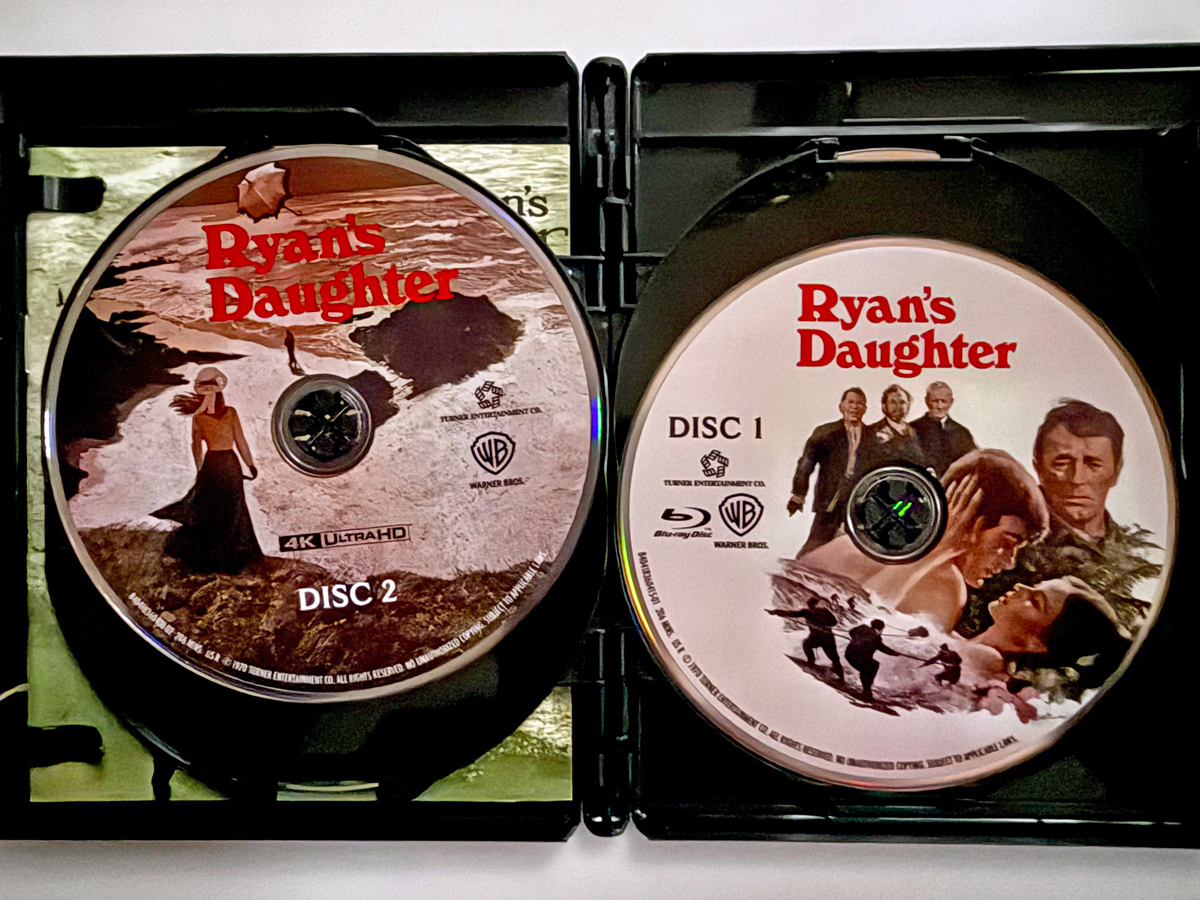 I was prepared for problems when the opening title sequence occurred, which was a time-lapse view of a spectacular sunrise. In the first twenty or so seconds, the screen is almost black, but a strange, broad, curvilinear band of faint grey overlay the middle of the image, as well as a similar grey patch in the upper right hand corner. However, my concerns evaporated as the sunrise illumination increased, and from then on, I can safely say this is the most fantastic film, image-wise, that I now have in my collection! Scene after scene, whether it be the spectacular locale, interiors, and particularly actor’s faces in close up, are all simply breathtaking. The image detail is so remarkable, that birds photographed at an enormous distance are clearly discernible, and the details of the sea, sand and rocks appear three-dimensional in character. No other dark scene shared the apparent blemish I noted involving the opening titles. The images are absolutely immaculate- not one dust particle or scratch is visible, yet the film does not appear “scrubbed.” Someone obviously cared deeply about preserving this negative, despite the avalanche of negative press the film received. The sound track is wonderful, with crisp dialog never overwhelmed by either the music or the sound effects. That holds for the most fearsome sequence, as well, namely, the storm. In that part of the film, the subwoofer does participate to give a very robust aural impression of the meteorological chaos. Also in that segment is effective use of the surround channels. Now that I have seen this film a third time, I feel the critics, especially those led by Schickel, unfairly judged the work, and indeed, I found the story enthralling, and its cinematic execution of the highest order. It’s true that the one sexually explicit love scene is punctuated by scenes of sunlight filtering through trees, as well as close-ups of flowers and branches, but to be honest, I think such a technique is a lot more romantic than the “clinical” approach now considered de riguer. It is also refreshing to be exposed to an intelligent script, not wordy at all, for Lean believed in the power of imagery and music to convey his thoughts, much like Hitchcock. The extras, while in standard definition, are very worthwhile, and just about anything you’d like to know about the production are contained in them. The price I paid, $24.95USD I feel is one of the great bargains, considering the extreme attention paid to provide the very finest restoration I believe I have seen to date. As a final word, I believe Warner Brothers Archive, who has brought us this absolute gem, also has in its possession the 1956 Best Picture, "Around the World in 80 Days.” I would hope they would lavish the same care to give this landmark film, which currently exists only on DVD as a transfer from its 35mm version, a proper 65mm sourced restoration, particularly the 30fps version. After all, it’s been 70 years since the film premiered, and some of us are still waiting for this opportunity to properly revisit it be realized. In the meantime, bravo to Mr. Feltenstein and his remarkable team at Warner Brothers! I cannot recommend this purchase more highly, and consider it an absolute must for the cinephile and video enthusiast. | |
 • Go to "Ryan's Daughter" in 4k UHD reviewed | |
| Go: back - top - news - back issues Updated 08-11-26 |