“Almost like a real web site”
 

IN7OMM.COM
Search | Contact
News | e-News
Rumour Mill
Foreign Language
Auf Deutsch

WHAT'S ON IN 7OMM?

TODD-AO PROCESS
Films | Premiere
People | Equipment
Library | Cinemas
Distortion Correcting
DP70 / AAII Projector


TODD-AO FESTIVAL
Through the Years | Festival Archive | Schauburg

7OMM FESTIVAL
Gentofte | Krnov
Bradford | Varnsdorf

VISION, SCOPE & RAMA
1895 Bioscop
1926 Natural Vision
1929 Grandeur
1930 Magnifilm
1930 Realife
1930 Vitascope
1952 Cinerama
1953 CinemaScope
1953 Panavison
1954 VistaVision
1954 Perspecta
1955 Todd-AO
1955 Circle Vision 360
1956 CinemaScope 55
1957 Ultra Panavision 70
1958 Cinemiracle
1958 Kinopanorama
1959 Super Panavision 70
1959 Super Technirama 70
1960 Smell-O-Vision
1961 Sovscope 70
1962
Cinerama 360
1962 MCS-70
1963 70mm Blow Up
1963 Circarama
1963 Circlorama
1966 Dimension 150
1966
Stereo-70
1967 DEFA 70
1967 Pik-A-Movie
1970 IMAX / Omnimax
1974 Cinema 180
1974 SENSURROUND
1976 Dolby Stereo
1984 Showscan
1984 Swissorama
1986 iWERKS
1989 ARRI 765
1990 CDS
1994 DTS / Datasat
2001 Super Dimension 70
2018 Magellan 65

Various Large format | 70mm to 3-strip | 3-strip to 70mm | Specialty Large Format | Special Effects in 65mm | ARC-120 | Early Large Format
7OMM Premiere in Chronological Order

7OMM ON EARTH

Australia | Brazil | Canada | China | Denmark | England | France | Germany | Holland | India | Iran | Israel | Ireland | Mexico | Norway | Poland |  Russia | Spain | Sweden | Turkey | USA |

LIBRARY
Interview | Eulogy
Academy of the WSW
7OMM Projectors
The 7OMM Newsletter
Back issue | Stories
70mm Workshop

7OMM NEWS
2026 | 2025 | 2024
2023 | 2022 | 2021
2020 | 2019 | 2018
2017 | 2016 | 2015
2014 | 2013 | 2012
2011 | 2010 | 2009
2008 | 2007 | 2006
2005 | 2004 | 2003
2002 | 2001 | 2000
1999 | 1998 | 1997
1996 | 1995 | 1994
 

in70mm.com Mission:
• in70mm.com is a free magazine-styled website dedicated to the promotion and preservation of any kind of 70mm film projection, a high-resolution film format. The website serves as a hub for contributing enthusiasts, filmmakers, and historians interested in the technical aspects, history, and cultural significance of 70mm film.

Disclaimer | About
Support us | Staff
Testimonials


Extracts and longer parts of in70mm.com may be reprinted with the written permission from the editor.

Copyright © 1896 - 2070. All rights reserved.


Visit biografmuseet.dk about Danish cinemas
 

"The Odyssey" Production Information

Read more at
in70mm.com
The 70mm Newsletter
Written by: Production information from Universal Pictures. Thanks to: UIP, CopenhagenDate: 18.07.2026
UNIVERSAL PICTURES Presents

A SYNCOPY Production

A Film by Christopher Nolan

The Odyssey

Shot entirely with IMAX film cameras

MATT DAMON
TOM HOLLAND
ANNE HATHAWAY
ROBERT PATTINSON
LUPITA NYONG’O
SAMANTHA MORTON
with ZENDAYA
and CHARLIZE THERON

Executive Producer
THOMAS HAYSLIP

Produced by
EMMA THOMAS
CHRISTOPHER NOLAN

Written for the Screen and Directed by
CHRISTOPHER NOLAN

• Go to “The Odyssey”: The 70mm Presentations
Universal Pictures
• Go to Now showing in 70mm in a theatre near you!

THE SYNOPSIS

Christopher Nolan’s The Odyssey is a mythic action epic shot across the world using brand new IMAX® film technology. The film brings Homer’s foundational saga to screens worldwide as the first feature film ever shot entirely with IMAX® Film Cameras.

The Odyssey stars Academy Award® winner MATT DAMON (Good Will Hunting, The Martian) as Odysseus, king of Ithaca; BAFTA winner TOM HOLLAND (Spider-Man series, Avengers: Endgame) as Odysseus’ son, Telemachus; Academy Award® winner ANNE HATHAWAY (Les Misérables, The Dark Knight Rises) as Penelope, queen of Ithaca and wife of Odysseus; ROBERT PATTINSON (The Batman, Good Time) as Antinous, an Ithacan suitor of Penelope; Academy Award® winner LUPITA NYONG’O (12 Years a Slave, Us) in dual roles as Helen of Troy, queen of Sparta, and as Helen’s twin sister Clytemnestra, queen of Mycenae; two-time Academy Award® nominee SAMANTHA MORTON (In America, Sweet and Lowdown) as Circe, a powerful witch; Emmy winner JOHN LEGUIZAMO (Moulin Rouge!, Romeo + Juliet) as Eumaeus, a faithful servant to Odysseus; Emmy and Golden Globe winner ZENDAYA (Challengers, Dune films) as the goddess Athena; Academy Award® winner CHARLIZE THERON (Mad Max: Fury Road, Monster) as Calypso, an immortal nymph.

JON BERNTHAL (The Bear, The Walking Dead) plays Menelaus, king of Sparta and husband of Helen of Troy; Emmy nominee HIMESH PATEL (Tenet, Yesterday) is Eurylochus, the second-in-command to Odysseus’ crew; Tony Award winner BILL IRWIN (Interstellar, Legion) plays the Cyclops, a one-eyed giant; Academy Award® nominee ELLIOT PAGE (Inception, Juno) is Sinon, a Greek warrior; Emmy winner BENNY SAFDIE (Oppenheimer, Good Time) plays Agamemnon, king of Mycenae; Emmy nominee COREY HAWKINS (Straight Outta Compton, BlacKkKlansman) plays Polybus, an Ithacan suitor; and MIA GOTH (Frankenstein, Pearl) is Melantho, a servant of Queen Penelope.

The Odyssey is written for the screen and directed by CHRISTOPHER NOLAN, based on Homer’s Odyssey. It is produced by EMMA THOMAS and CHRISTOPHER NOLAN for their company, Syncopy. The executive producer is THOMAS HAYSLIP.

The film’s director of photography is Academy Award® winner HOYTE VAN HOYTEMA, ASC, FSF, NSC (Oppenheimer, Dunkirk) and the production designer is Academy Award® nominee RUTH DE JONG (Oppenheimer, Us). The costumes are designed by Academy Award® nominee ELLEN MIROJNICK (Oppenheimer, The Greatest Showman) and the makeup designer is Academy Award® nominee LUISA ABEL (Oppenheimer, Tenet). The hair designer is Academy Award® nominee GLORIA CASNY (The Lone Ranger, Ford v. Ferrari).

The film’s editor is Academy Award® winner JENNIFER LAME, ACE (Oppenheimer, Tenet) and the music is by three-time Academy Award® winner LUDWIG GÖRANSSON (Oppenheimer, Sinners). The visual effects supervisor is Academy Award® winner ANDREW JACKSON (Oppenheimer, Tenet) and the special effects supervisor is two-time Academy Award® winner SCOTT R. FISHER (Oppenheimer, Tenet).

The co-producers are ANDY THOMPSON (Oppenheimer, Tenet) and HELEN MEDRANO (associate producer on Oppenheimer, Tenet) and the casting is by JOHN PAPSIDERA, CSA (Oppenheimer, Tenet).

Christopher Nolan’s films, including Oppenheimer, Tenet, Dunkirk, Interstellar, Inception and The Dark Knight trilogy, have earned more than $6 billion at the global box office and have been awarded 18 Oscars® from 49 nominations. In 2023, Oppenheimer earned almost $1 billion worldwide and went on to win seven Academy Awards®, including for Directing and Best Picture.
 
More in 70mm reading:

“The Odyssey”: The 70mm Presentations

"Oppenheimer" Production Notes

About "Oppenheimer" and Large Format

"Oppenheimer" is Christopher Nolan's next adventure in IMAX 7OMM

TENET, the last 15/70mm picture show?

"Tenet" Production Info

"Dunkirk" filmed in 65mm with IMAX cameras

Acclaimed filmmaker Christopher Nolan directs an international cast in “Interstellar”

A review of "The Dark Knight" in IMAX
 
THE BACKSTORY

From Academy Award® winner Christopher Nolan, The Odyssey brings to the screen Homer’s heroic epic, a literary work regarded as the foundational text of western culture. Shot in six countries with an all-star cast, Nolan’s thirteenth feature fulfills a dream of many years to film an entire movie using IMAX Film Cameras, and it represents his most immersive and expansive cinematic experience yet.

“Your experience as a filmmaker informs the choices you make in a number of different ways, including what you feel prepared for, what you feel that you have the skill set for, and what will give you a new challenge but builds on what you’ve done before,” Christopher Nolan says. “The Odyssey is an incredible work that’s extremely important to the history of the world and development of culture, but it has never been adapted as a modern blockbuster. I was energized by the challenge of creating the mythic world of Ancient Greece and excited about telling its story, with all its rich themes, in a way I’d never seen.”

A massive poem of 12,109 lines attributed to Homer, whose very existence is debated by modern scholars, The Odyssey and its equally monumental prequel, The Iliad, are believed to have been composed in the 8th century BCE, though they most likely evolved in language and content as they were sung and re-sung by generations of oral storytellers. Together, they form a fantastical myth about the end of the Bronze Age.

The Odyssey is a unique saga. A non-linear narrative with many flashbacks, parallel plots, stories within stories, and meta-commentaries, the poem is structured around two central figures: Odysseus of Ithaca, king of a rocky Greek isle, who wins the war for Agamemnon with his iconic gambit, the Trojan Horse; and Telemachus, his young adult son, who was an infant when his father left for Troy. As Odysseus embarks on a crucial leg of a homecoming journey troubled by gods and monsters, storms and tragedy, Telemachus searches for hope that his long-lost father is still alive amid a mounting crisis on Ithaca threatening him and his mother, Penelope: a pack of wolfish princes and noblemen have taken residence in the family palace and are pressuring the queen to give up on Odysseus, marry anew, and make one of them king.

Central to The Odyssey are a pair of interconnected themes expressing ideals and values crucial to the culture of ancient Greece. The first is xenia (“guest friendship”), the practice of extending generous hospitality to strangers. Also known as “the law of Zeus,” this code of conduct was considered a civic and divine duty, and its violation by host or hosted was considered shameful and impious. The custom helped Greece cultivate allies and build a network of trade. The second major theme, nostos (“homecoming”), was understood to be a literal voyage of return and a spiritual process of rebirth, in which a quest for home and any of its rewards—reuniting with loved ones; reclaiming lost titles and riches; forging a more mature, life-giving identity—requires trials that test or reshape character.

“Whether it’s the narrative through-line of Odysseus or the singular episodes that make the entirety of the epic, The Odyssey underpins almost all of cinema,” Nolan says. “It’s certainly there in every movie I’ve ever made, to a degree I never before realized. It was a fun thing to discover as I got into the work of adaptation.”

Like many people of his generation, Nolan first encountered The Odyssey in abridged form during his elementary school days. He recalls watching kids in the older grades performing a theatrical adaptation; he was captivated in particular by the tale of the Trojan Horse and the poem’s overtly fantastical elements, like the Cyclops, a one-eyed giant, and Sirens, nymphs who cause sailors to run aground by enchanting them with song. “For a lot of us, it’s always there, in the back of the mind,” Nolan says. ”And it’s very present when you encounter elements that have been reinterpreted for modern stories.”
“There’s certainly been some incredible, innovative work done in earlier eras of Hollywood in the area of Greek mythology,” says Nolan, citing in particular his admiration for Jason and the Argonauts (1963) and Clash of the Titans (1984), both of which featured the artistry of special effects pioneer Ray Harryhausen. “But the more I thought about it, the more I was intrigued by the idea of taking on the biggest of stories, with a top-level budget, a top-level cast, and pouring all the modern techniques and resources of a massive Hollywood production into this world.”

While The Odyssey presents a daunting task for a writer seeking to adapt it, Nolan’s previous work had prepared him well for it. The poem’s non-linear narrative and parallel quests of two enmeshed characters, Odysseus and Telemachus, resembles Nolan’s approach to Oppenheimer. It has many distinct episodes, set in varied extreme environments, much like Inception, and it has an array of action sequences, from a massive battle involving opposing armies to stealth missions into dangerous locales, all challenges that Nolan has met before in his films Dunkirk and Tenet.

And Odysseus is a mythic exemplar of every Nolan protagonist: ingenious, principled yet morally slippery, defined by a complex mystery of character. “The thing I loved about the poem when I read it again, once I knew that this was what Chris wanted to do, was seeing how perfectly it fit into the way Chris tells stories,” Thomas says. “It’s nonlinear; there are scares, thrills, and great reveals.”

Contrary to some common assumptions about both The Iliad and The Odyssey, the former poem doesn’t describe the end of the Trojan War, and the latter only mentions the Trojan Horse in flashbacks. (It is likely the original audience already knew the lore, possibly because of familiarity with other epic poems of the time that are now lost to history.) Because depicting the infiltration and sack of Troy was crucial to Nolan’s adaptation, he integrated details and characters from surviving sources that do offer a more robust description of the Trojan Horse gambit, including The Aeneid, an epic poem composed in the 1st century BCE attributed to the Roman poet Virgil and Agamemnon by Aeschylus.

As Nolan locked into a characterization of Odysseus and developed the story, an ambitious aesthetic for the production began to emerge, one rooted in the director’s pursuit of verisimilitude, no matter how fantastic the genre or story might be. “What I’ve been doing in my films over the years, whether you look at The Dark Knight or Interstellar or Inception, is taking fanciful ideas and grounding them in reality,” Nolan says. “If the films have worked, I think some of their power and appeal come from that they earned their worlds with an audience, so the audience could believe in exciting, outlandish things.”

At the same time, Nolan wanted his version of The Odyssey, a story set almost 3,000 years ago, to be relatable to modern moviegoers. His desire is consistent with the first bards who sang their own adaptations of the poem, tweaking syntax, introducing regional vocabulary, emphasizing certain themes or altering plot points so that their audiences could see themselves reflected in the tale. “I made a decision when I was writing the script that I wanted the film to be accessible,” Nolan says. “I wanted the world of The Odyssey to feel like a world that a modern audience could relate to. We didn’t want it to look or sound like previous movies set during antiquity, as many of them take their cues from certain periods of art and music, like Neoclassical painting from 18th and 19th century Europe or Romantic Era orchestral compositions. We wanted an earthy, modern, relatable tone to ground the story.”

Nolan’s passion for finding production value in real locations, live stunt-work and practical or “in-camera” effects is well documented. But he has never been averse to using visual effects as needed—in fact, his films have won three Oscars® for Visual Effects— and he has been at the forefront of advancing techniques in both filmmaking and theatrical exhibition, particularly in his passion for IMAX. To make Oppenheimer, Nolan and his cinematographer, Hoyte van Hoytema, worked with IMAX and Kodak to create 15-perf 65mm black and white film stock for the 15/65mm IMAX cameras used for that film. Coming off that triumph, Nolan recognized he was in a unique position to make The Odyssey using every technique and technology at his disposal—and incorporate some new ones, too—and on a scale that matched his previous movies if not surpassed them.

“I’m a big fan of film history, particularly the silent era,” Nolan says. “Some of the attractions of cinema to audiences back then were things that also speak to audiences now. Extraordinary sets, extraordinary locations, a cast of thousands. Part of the appeal of those spectacles was that these effects were generated practically, with real sets, locations and scores of extras. Over time, with visual effects technology, a lot of that got lost. What has long interested me is the ability to combine those two things to create the most immersive and powerful experience possible. We can return to an older era of filmmaking, where ‘in-camera’ spectacle was everything for audiences. But we can also address the fantasy through the power of visual effects. For me, this synthesis was an appeal of the project. We are trying to do it all. Which seems totally appropriate for what the Odyssey is and needs to be on screen.”

Moving into pre-production, Nolan and Thomas assembled a team of both familiar and new collaborators, all of them game for the challenge of making a movie “that felt like seven different ambitious movies all rolled into one,” Thomas says. “I think Chris was at the right point in his career to make this film. Everyone was. Everything we have done in the past prepared us for this, because everyone needed to be at the top of their game to pull this off. As a producer, I am often the person sitting at the side of the room in prep, listening to the creative conversation. There were a lot of meetings where it was like watching an orchestra play an incredibly complex symphony. It was incredible watching people analyze the problems that they were going to face and figure out the best way to attack them and achieve the seemingly impossible.”
 
Not that it was easy. It wasn’t, as everyone involved will tell you. Repeatedly. But this, too, is fitting, says Nolan: “It was a hard job—as it should be. It’s The Odyssey.”


THE CHARACTERS

ODYSSEUS

MATT DAMON

After ending the siege of Troy with a cunning gambit that produces devastating consequences, Odysseus and his loyal soldiers set sail for home: Ithaca, an island kingdom, where the hero’s wife, Penelope, and son, Telemachus, wait. His twisting, turning journey is troubled by tempestuous forces, inhospitable beings and his own folly and conscience, leading to fraught reunions and moral reckonings.

To play Odysseus, Christopher Nolan drafted Matt Damon, who rocketed to stardom with Good Will Hunting (and won an Academy Award® for co-writing its screenplay) and whose many indelible performances include his Oscar®-nominated turns in The Martian and Invictus. Because of their previous collaborations—Damon played bomb-building Col. Leslie Graves in Oppenheimer and wayward astronaut Dr. Mann in Interstellar—Nolan had no doubt the actor could both embody and help lead The Odyssey.

“I needed Matt because I needed someone who had extraordinary talent and an incredible connection with the audience, and he was just in the right place in his life and career to play this part,” Nolan says. ”Odysseus is somebody with great imagination and wisdom, but he has a weary quality, too. It is a mature role with a lot of complexity to it and very difficult to play, but Matt really sunk his teeth into it. I also needed someone who was not just willing to go on a rigorous journey but help lead it. And Matt is somebody who brings such positive energy to everything he does. It feeds his craft and art, and he is able to channel the angst of difficult shooting circumstances into a character. He is an incredible motivator and a wonderful example to the rest of the cast and crew. The film would have been unthinkable without him.”

For Damon, working with Nolan is such a no-brainer, he forgot to ask an important question when the director inquired about his availability for a new project. “I said yes before he even told me what it was,” Damon says. “Chris said: ‘Don’t you want to hear the pitch?’ I said: ‘Okay, sure.” And he said two words: ‘The Odyssey.’”

After first reading Homer’s poem and then Nolan’s screenplay, Damon was struck by the adaptation’s quality and by the resonant themes Nolan brought to the forefront. “It reminded me of his script for Oppenheimer, because that film was also drawn from a dense, substantial book, and he found an amazing way to distill it to its essentials without losing any of its plot, themes or richness,” Damon says. “Chris has restructured the narrative in an artful way that gives it real economy, and the themes he emphasizes give it a distinct identity and meaning. But it is still very much Homer’s Odyssey. It also has a strong emotional core and through-line that feels deeply personal. There is a universality in its specificity that I think will move anyone. The themes certainly resonated with my own life. It was an incredible piece of writing.”

To prepare for what Damon calls “the role of a lifetime,” the star of the Jason Bourne franchise got into action hero shape, not just to flesh out the character, but to endure the rigors of production. “Chris told me in one of our first meetings that was going to be a hard movie,” Damon says. “I said, ‘Yeah, I know.’ And he goes, ‘No, this is going be a really hard movie.’ From the very beginning, I was mindful of not just what he wanted me to look like physically, but what being fit meant to the production, being diligent about my health, nutrition, and rest while filming, so that I am not sustaining any preventable injury that could slow us down and cost us days.”

Leaning into Nolan’s exhortation served Damon well on a filmmaking adventure around the world and in extreme conditions that was as arduous as it was exhilarating. “Every location we went to, I would get there and I would just start laughing, like, ‘Who thought you should shoot a movie here?’” Damon says. “I remember when we got to Iceland after shooting in these hard places, everybody kept saying, ‘Iceland will be easy; it’s summertime.’ And Iceland said, ‘Hold my beer, watch this.’ Night shoots on black sand beaches, rain hitting us sideways in the face, windy, cold. There were no easy days on the movie. Every day would have been the hardest day on any another movie. But it was always amazing and rewarding and the camaraderie was incredible. There is something about turning around and seeing the same group of people every day, knowing that every single department is absolutely maxing out.”

At journey’s end, Damon says he feels deeply grateful for a seminal experience in his career. “I feel like my whole life was kind of leading up to this movie in a way,” Damon says. “It’s the biggest movie that I have ever done in terms of its scale. Definitely the biggest movie I have ever made in terms of its ambition. I don’t know how long we are going to get to make movies this way, so I had this feeling of almost nostalgia the entire time. And it really changed my perspective on the things that are hard and challenging. Because they never really felt that way on this movie, even at its most daunting, which speaks volumes about Chris and Emma and their team and everyone who wanted to be part of this. It was a profound experience for me and really, really fun.”
 
 
PENELOPE

ANNE HATHAWAY

Complex and circumspect, a queen and wife whose grace masks true steel and simmering fury, Penelope waits for Odysseus’s return while suffering the interest of predatory suitors she is forbidden to refuse by custom, keeping them at bay with a guile equal to her husband. In the struggle to save herself and all that is important to her, she proves more than a match for the men trying to possess her.

To play Penelope, Christopher Nolan turned to another trusted collaborator, Academy Award® winner Anne Hathaway (Les Misérables), who starred as anti-hero cat burglar Selina Kyle in The Dark Knight Rises and astronaut-scientist Amelia Brand in Interstellar. Her other performances in her acclaimed career include Rachel Getting Married, which earned her an Oscar® nomination, The Devil Wears Prada and its recent blockbuster sequel.

“Anne conveys a maturity and stillness as Penelope that is remarkable,” Nolan says. “Penelope is controlled and strategic on the surface, navigating the dangerous politics of Ithaca with apparent calm, but Anne is able to convey all the passion Penelope has to hide. I’ve worked with Anne twice before, and I knew I needed her incredible ability to play the layers of this character, to bring out the tension between Penelope’s controlled exterior and the intense emotions underneath.”

For Hathaway, there was no refusing The Odyssey, and not just because Christopher Nolan was directing it. “When Chris told me what he was doing, I had zero calm about it because I am completely in love with Greek mythology and have been since the eighth grade,” Hathaway says. “In my spare time I watch shows about Greek mythology and my favorite thing is alternative literature that retells Greek mythology. So, The Odyssey occupies a very special place in my heart. It is among the greatest pieces of storytelling that human beings have ever produced: a blend of philosophy and myth, emotion, logic and scope and imagination. When Chris said that he was going to tell the story, I thought, ‘Well, there is no better filmmaker-material pairing than that.’”

Among many things that impressed Hathaway about Nolan’s adaptation of The Odyssey was its perspective on Penelope. “In all of my years imagining the story, the Penelope that Chris wrote is beyond anything I could have anticipated,” Hathaway says. ”She had so much fire and passion inside of her. One of the things I appreciated so much was that Chris brought in the possibility that Penelope might have felt misunderstood and that that is part of the bond that she shares with Odysseus. I also thought it was wonderful that Chris really attended to the relationship between Odysseus and Penelope. They’re important figures to other people, but in many ways the story hinges on what they mean to each other and the quality of life that they experience when they are together.”

Hathaway credits costume designer Ellen Mirojnick and make-up designer Luisa Abel with helping express the character and inspire her. “Ellen has such an open heart, sure hand, and I am going say it, genius,” Hathaway says. “I wear ten outfits in the film, and they are a vibrant splendor of colors, as colors on Penelope should be. They tell you something about a woman whose husband has been missing for a very long time: they tell you she does not think of herself as a widow, that this queen dresses like a queen every day, in part because this could be the day he comes home. It meant that I do not need to speak a word, and you know exactly what you need to know about Penelope.

“And Luisa is an extraordinary master of her craft,” Hathaway continues. “I was so grateful for how rigorous she was about testing different makeups to create something that allowed the story to be told, that wasn’t distracting, and that allowed the passage of time to be shown. Everything was applied intentionally and delicately, and that set you up well for the day’s work: you always felt like you were a part of something.”

Another part of Hathaway’s preparation to play Penelope: Learning how to weave with a loom. “Christopher Nolan and Emma Thomas found me the most amazing, extraordinary teacher in Northern California who is an expert at weaving thread with ancient kinds of looms,” Hathaway says. “We began with a simple, starter loom and worked our way up to a much bigger one. There was a moment when everything just clicked, like I was connecting with a skill that is foundational to being a human being. To be clear, it takes years to learn how to make something truly beautiful and intricate with a loom. But I am grateful I learned what I did so I cast the illusion of it and make you believe Penelope herself had spent years at her loom.”
 
 
TELEMACHUS

TOM HOLLAND

The only child of Odysseus and Penelope, Telemachus fears for his life and the fate of his mother as a pack of predatory men angle to wed her and gain control of Ithaca. He travels the Ionian isles seeking insight into what happened to his father and looking for reason to hope for his imminent return. His own journey is a coming-of-age story in which he must accelerate into maturity to help save his family and secure the future of Ithaca.

Playing Telemachus is Tom Holland, who announced himself as a major young talent in the 2014 disaster film The Impossible and gained international stardom by playing Peter Parker, aka Spider-Man, in the Marvel Cinematic Universe. He achieved further renown and acclaim for his performances in The Lost City of Z, Uncharted, and the Apple TV+ series The Crowded Room. “Telemachus is a boy becoming a man through his own journey: a son protecting his mother and reconnecting with a father he thought he had lost,” Holland says. “But it is also about a young person seeing the craziness of his world and figuring out his proper place in it.”

For Christopher Nolan and Emma Thomas, Holland proved to be the perfect choice to embody the role. “I’d never had the chance to work with Tom before, but have long admired his extraordinary talent,” Nolan says. “Working with him confirmed for me that he’s one of the great actors of his generation, bringing a commitment and focus to his work that combines raw talent with a disciplined process aimed at inhabiting the truth of the character. The Odyssey is , in large part, the story of Telemachus’s coming of age, and Tom has brought a sensitive understanding of the layers and complexities of this character that are essential to the tale.”

Adds Thomas: “I don’t think I had ever realized what physical actor Tom is. Obviously, I have seen his work, but you don’t really understand it until you see him do it in person. In fact, because Telemachus is a young man still coming into his strengths and quality of character, there were moments where Chris had to be saying, ‘Please don’t do it quite as well! You’re not meant to be an expert yet!’ He was just fabulous.”

Holland had spent years hearing about what it is like to make a Christoper Nolan movie from his longtime Spider-Man stunt coordinator, GEORGE COTTLE, who has worked with Nolan on all of his films since Batman Begins. “For the last decade, George had been telling me about the wonders of a Chris Nolan set, and I was always like: ‘How different can it really be?’” Holland says. “But you can’t understand it until you see it for yourself. I remember my first day, in Morocco, the scope and scale were really overwhelming. And the IMAX cameras almost take you back to square one as actor: You have to kind of throw out techniques you’ve learned with a digital camera or a smaller camera and learn how to dance with the camera. But Chris and his team are so great at giving you the time you need to adjust to their style and their way of working. It was incredibly fulfilling.”

One new talent Holland had to develop on the job was somewhat ironic: while he has spent over a decade doing some of the most complex fight scenes in recent movie history as Spider-Man, The Odyssey required him to meet a similar standard while showing his face. “We were not doing action for the sake of action; we were trying to serve the characters and propel the story forward,” Holland says. “We shot this one fight. I’d learned it; I had it absolutely down. We did it a few times and Chris said, ‘I need you to be more tied into what this other character is doing.’ Which is not always something I have had to think about. I am used to doing fight scenes with a mask on, so I had to learn how to incorporate more performance into the grandeur of the fights.” By all accounts, he nailed it. “Tom had to know his part of that fight inside and out,” Nolan says. “And he had to be able to do it quickly, efficiently, and repeat it as we needed for days. Fortunately, he’s an extraordinary athlete.”

Working with Nolan, his crew and this cast was an apex career experience for Holland. “It reminded of being 18 and on set with all the Avengers for the first time and being blown away by it,” Holland says. “I just feel so lucky to be a part of it. Everyone brought their absolute A-game. Every day I watched amazing people give their best and do their best. It was such a joy.”
 
 
ANTINOUS

ROBERT PATTINSON

Among the many pretenders to Odysseus’s throne who have taken up residence in his palace on Ithaca, none is more sinister than Antinous, who loses patience with Penelope’s refusal to choose a new husband and so hatches a scheme to force her hand.
To play Antinous, Christopher Nolan tapped one of his Tenet stars, Robert Pattinson, who soared to fame playing Edward Cullen in the Twilight franchise and now plays the dark knight in The Batman movies. “Rob is an actor who loves to challenge himself and defy expectations,” Nolan says. “Playing Antinous allowed him to do both, and it was such a thrill to see him arrive on set every day, always bringing surprises in terms of how he was going to play the charm, menace and cruelty of this bizarre and broken character. All of Rob’s choices are thought through and grounded in the history and truth of this cowardly and ambitious figure.”

Pattinson quickly locked into a specific take on Antinous. “Antinous represents a kind of a modernity that’s without ethics,” Pattinson says. “I wanted him to be sort of glamorous in this quite primitive environment. He is very peacock-y, but he is a guy who doesn’t want to fight. He can tell other people to be violent, but he wants a kind of stolen valor. He wants to enjoy the wealth that better men have gained.” To help represent his vision of the character, Pattinson worked closely with costume designer Ellen Mirojnick. “We ended up doing lots of experiments with different kinds of materials,” Pattinson says. “And we experimented with gold thread—the implication being that Antinous is wearing golden underwear.”

Shooting in Favignana, Italy, for three weeks required a daily trek, on foot, up a steep hill to an ancient castle—a tough commute, but one that brought cast and crew closer together. “When you are shooting a Chris Nolan movie, it’s a 45-minute hike up a hill in sandals and full costume,” Pattinson says. “But it does something to you. You really feel like you are on a quest going somewhere, and it’s a great equalizer. For every member of the crew, every member of the cast, you are experiencing the same thing. It’s a positive bonding experience.”

Nolan himself was energized by it, too. “One of the things I like about shooting on location is that we’re moving countries or places every couple of weeks, and you’re getting a fresh perspective,” Nolan says. “It gives you this incredible momentum. To achieve the scale of this film, you wanted to be in extraordinary places that were hard to get to, hard to shoot in. This was, by far, the most intense and the most arduous for people of any film we’ve done.”

Pattinson’s second tour of duty with Nolan left him with even greater admiration for the director’s approach to filmmaking. “There must be an extreme amount of pressure on him, but he still manages to make it a fun experience when you’re shooting,” Pattinson says. “I actually thought Chris seemed calmer on this than he did on Tenet, which is crazy. He’s just not wired like other people; I think his polarity is the wrong way around. I mean, he does seem to choose the hardest possible way to make movies every single time. How do you go from, ‘I’m going to do a practical nuclear bomb,’ to ‘I want do everything possible to make a literal whirlpool in the Mediterranean Sea?’ It’s so insane!”
 
 
HELEN AND CLYTEMNESTRA

LUPITA NYONG’O

Helen is the queen of Sparta, married to King Menelaus. Helen’s ambiguous relationship with Paris, a young man so captivated by her legendary beauty that he spirited her away from her home (and husband) to Troy, sparked the Trojan War. One of the great mysteries of ancient literature is whether Helen was taken hostage by Paris or went with him willingly. Now, after a bloody ten-year war that ended with the Pyrrhic victory of Menelaus (Emmy winner Jon Bernthal; The Punisher, The Bear) and the Greeks, Menelaus has returned home with his prize, Helen. They’re still working out some issues.

Playing Helen, the fabled “face that launched a thousand ships,” is Lupita Nyong’o, who won an Oscar® in her big screen debut, 12 Years A Slave, and has since starred in such acclaimed films as Black Panther and A Quiet Place: Day One. “It’s quite intimidating to play a woman who, in Greek myth, is said to be the most beautiful woman in the world,” Nyong’o says. “But I was really interested in figuring out who the woman was beyond the face. To be clear, I would have pulled cable for Chris Nolan, so when he told me who he wanted me to play, I was actually floored by it.”

Who he wanted her to play, it turned out, was plural. Nyong’o also plays Helen’s twin sister, Clytemnestra, queen of Mycenae and wife of fearsome and imperious King Agamemnon (Emmy winner Benny Safdie; Oppenheimer, Licorice Pizza). As different as their personalities are, Helen and Clytemnestra are both in turbulent marriages, for different reasons. “It’s one thing to work with Chris once, but it’s another to work with him twice in one movie,” Nyong’o says. “It was exciting to play twins and find nuance in both of them.”
 
 
CALYPSO

CHARLIZE THERON

During his journey home to Ithaca, a lost Odysseus spends an extended sojourn on the island of Ogygia, home to the entrancing Calypso, regarded in Greek mythology as a nymph and the daughter of an old god, Atlas.

Playing Calypso is Charlize Theron, star of Mad Max: Fury Road, who won an Academy Award® for her lead performance in Monster and picked up additional nominations for her work in the dramas North Country and Bombshell. “Charlize embraced the high-wire act we wanted to achieve with Calypso,” Christopher Nolan says. “Throughout history, that character has been interpreted in vastly contradictory ways, and trying to resolve those contradictions required somebody of Charlize’s intellect and empathy.”

Not unlike Helen, the motives and character of Calypso have been much debated over the centuries. Is she offering Odysseus a glimpse of immortality or preventing him from finding his way home? Is she a refuge or a cage? Is she in love with him or simply wanting to possess him? Over time, Calypso has been viewed as both villain and tragic figure. “I see her as all of those things and also none of those things,” Theron said in a recent interview, adding that she relishes playing one of the saga’s least-known characters. “I was given a chance to do something that I haven’t had a ton of opportunity to do, because she’s a little bit of everything. That’s what’s so beautiful about her. Even though she’s a goddess, she is longing for connection. And it was interesting to look at somebody with the powers that she has, but who still really couldn’t do that much with them.”
 
 
ATHENA

ZENDAYA

In Greek mythology, Athena is regarded as the daughter of Zeus and the goddess of craft, warfare and wisdom. Following the sack of Troy, she periodically appears to Odysseus, reminding him of who he is, what he has done, and where he must go.

To play Athena, Christopher Nolan cast Zendaya, who has earned global acclaim for her roles in Challengers, The Greatest Showman, and the Spider-Man and Dune franchises. She was thrilled for her co-star and partner, Tom Holland, when he got the role of Telemachus. She was even more excited when Holland came home from a meeting with the director with some news.

“I remember when Tom got his call and I was over the moon for him to get the opportunity to be in Christopher Nolan’s next film,” Zendaya says. “It never crossed my mind that there would be an opportunity where we would both be able to be a part of this. I was just excited that he was doing it. So, when he came home and said, ‘Chris wants to talk to you about something,’ I said: “Wait – what?!’ It was like I had won the lottery. It’s so special to be able to watch everyone work and watch someone you love work, then be able to be there with them and work with them, too. Coolest job on the planet.”

Zendaya found her way into Athena by focusing on her human qualities and her connection to Odysseus. “I really connected with the emotional component of it,” Zendaya says. “Athena becomes a reflection of the moral struggle that Odysseus is having within himself. You realize that the manifestation of this goddess is a kind of tough love, guiding him and bringing him through his journey. In a deeper sense, I think he is haunted by the decisions that he has made and the pain that he has caused. Coming to terms with that is part of fighting to get back to his own family.”

Her first days of work were spent shooting the sack of Troy on the film’s gigantic immersive set in Morocco. “I was so nervous,” Zendaya says. “Let’s just say it was intense. And that’s to say nothing of the world Chris created for us. The sets are so massive and there’s so much detail and thought in every costume, set piece. I didn’t have to do much acting because I felt I had stepped into Troy. But it was exhilarating and almost felt like a dream. It was cold and raining, but I think with the adrenaline, I didn’t feel it. Everybody kept asking me, ‘Do you want a jacket?’ I was so fired up I forgot it was cold.”

Befitting the incarnation of wisdom that she plays, Zendaya says that what sticks with her most about the experience are the deeper meanings of Nolan’s adaptation. “I found it very human and very emotional,” Zendaya says. “It is a story about love, whether it’s the love for your people or your children or your partner. But ultimately it’s a story of love for other human beings. In the movie, this is codified in Zeus’s law, or what we know now as The Golden Rule: Treat people the way you want to be treated. Which is something we need to be reminded of. We often forget to see other people as human beings, see life through their eyes, see their pain, see the effect you have on other people. That, to me, was the emotional meaning of the story.”
 
 
CIRCE

SAMANTHA MORTON

Circe is an earthy witch who lives a solitary life on the island of Aeaea. She is not accustomed to visitors, and those who offend her with rude manners and inappropriate behavior tend to meet strange yet ironically fitting fates. In Greek mythology, she is regarded as the daughter of an older sun god, Helios, and the ocean nymph, Perse.

Playing Circe is Samantha Morton, a two-time Oscar® nominee (Sweet and Lowdown; In America) whose other work includes memorable performances in Morvern Callar, Minority Report and The Messenger. She came to The Odyssey having never read the poem, but she was immediately taken by Christopher Nolan’s adaptation of the character. “I just had a gut, a visceral reaction to the script and went with that,” Morton says. ”Circe represents, in many ways, the misunderstanding and vilification of women. I felt a real connection to her response to the soldiers who come to her island and what they do and what they represent, including the structures of hierarchy and power in her world.”

Morton calls her experience of working with Nolan on The Odyssey a “rebirth” that reconnected her with the power and possibilities of cinema. “I have been acting for a very, very long time now, since I was about 12 years old,” Morton says. “Often now, directors just expect you to turn up and do your thing. But it is so wonderful when people both expect a lot from you and aren’t afraid to direct you, to collaborate and create with you and make you better. So, to be directed and be better than you thought you could be is amazing. Working with Chris, it was refreshing to see that somebody can be a genius at his craft and also be a gentleman: respectful, helpful, and polite.”
 
 
EUMAEUS

JOHN LEGUIZAMO

Eumaeus, Odysseus’s loyal and loquacious friend and swineherd, faithfully attended Penelope and Telemachus on Ithaca during his king’s many years away. Eumaeus and his scrappy dog, Argus, prove invaluable to the royal family in their efforts to thwart Penelope’s sleazy suitors and their violent endgame conspiracy.

Playing Eumaeus is John Leguizamo, whose nearly 40 years of acting work in Hollywood includes such films as To Wong Foo, Thanks for Everything! Julie Newmar, Moulin Rouge!, and John Wick, and whose acclaimed one-man variety shows, including Freak! and Latin History for Morons, have earned him both Emmy and Tony awards.

“I was so excited when I got the call that Chris Nolan wanted me to be in his next movie because he is easily one of the great directors of our time,” Leguizamo says. “But when I heard it was The Odyssey, I was like ‘Who the hell am I going to play?’ Chris said: ‘You’re going to be playing the most loyal character in Western literature.’ And I thought: How could I resist that?”

To prepare for playing a character who is blind, Leguizamo consulted with a friend who had lost her eyesight when she was young. While working with the make-up department to test contact lenses that create the illusion of the character’s cataracts, Leguizamo came up with the idea that each lens should he a different color. The choice contributes to a unique look for the character that somewhat disturbed him when looked in the mirror. “They had to age me by a few decades,” Leguizamo says. “Wrinkles in the neck. Hair is bleached—‘fried and dried and left outside,’ as they say in the beauty business. They would stretch my face, then create wrinkles and age spots and broken capillaries. It was all so realistic and disconcerting. I thought, ‘Am I going to look like this if I should get so old?!”

The crew, and the star of the movie, had his back. “Matt Damon was such a sweetheart,” Leguizamo says. “I have such huge respect for him. He’s such a testament of what you can be as a star. You don’t have to be a diva. You can be a really nice person and treat everybody with respect.”

Leguizamo’s other co-star didn’t say much: the dog that played Argus. “The dog is a Portuguese Podengo,” Leguizamo says. “There are only, like, 75 of them in the world or something. They are an ancient Italian breed.”


THE CINEMATOGRAPHY

The Odyssey marks the fifth collaboration between Nolan and director of photography Hoyte van Hoytema, who won an Oscar® in 2023 for lensing Oppenheimer. In addition to Interstellar, Dunkirk and Tenet, van Hoytema’s other acclaimed work includes Let the Right One In, The Fighter and Spectre. Despite his many collaborations with Nolan, van Hoytema didn’t know what Nolan was working on until the filmmaker handed him the completed script.

“Chris called me over and said two words: ‘The Odyssey.’ Then he gave me the script,” van Hoytema says. “He never hinted at it, which is not unusual; he is extremely discrete when he is writing something new. I wasn’t surprised by the ambition of it all. By now, I know Chris isn’t one for air-conditioned soundstages and well-heated rooms. Of course, he’s going to want to get out there in the elements, be on boats, and travel to places where it’s hard to shoot. He loves that. I do, too. So, the project felt very classic, coming from him, but it also represented something new in various ways.”

“An intimate epic” is how van Hoytema characterizes the aesthetic that he and Nolan wanted for the film. “The story itself is always described as an epic story about a journey across wide seas and long distances,” van Hoytema says. “But our focus was never on the scope, per se; the goal for us was to make an epic on a very intimate scale. It is a personal story about a man trying to get back to his wife and son, and willing to do whatever it takes to get there, set in an extremely dramatic, imminently cinematic backdrop. So, the film is designed to put people in the shoes of our heroes, in particular Odysseus, and feel what they feel, and connect with two things in particular: his yearning and longing for home; and the heavy moral dilemmas and ethical questions he encounters along the way.”

IMAX INNOVATION: “THE BLIMP”

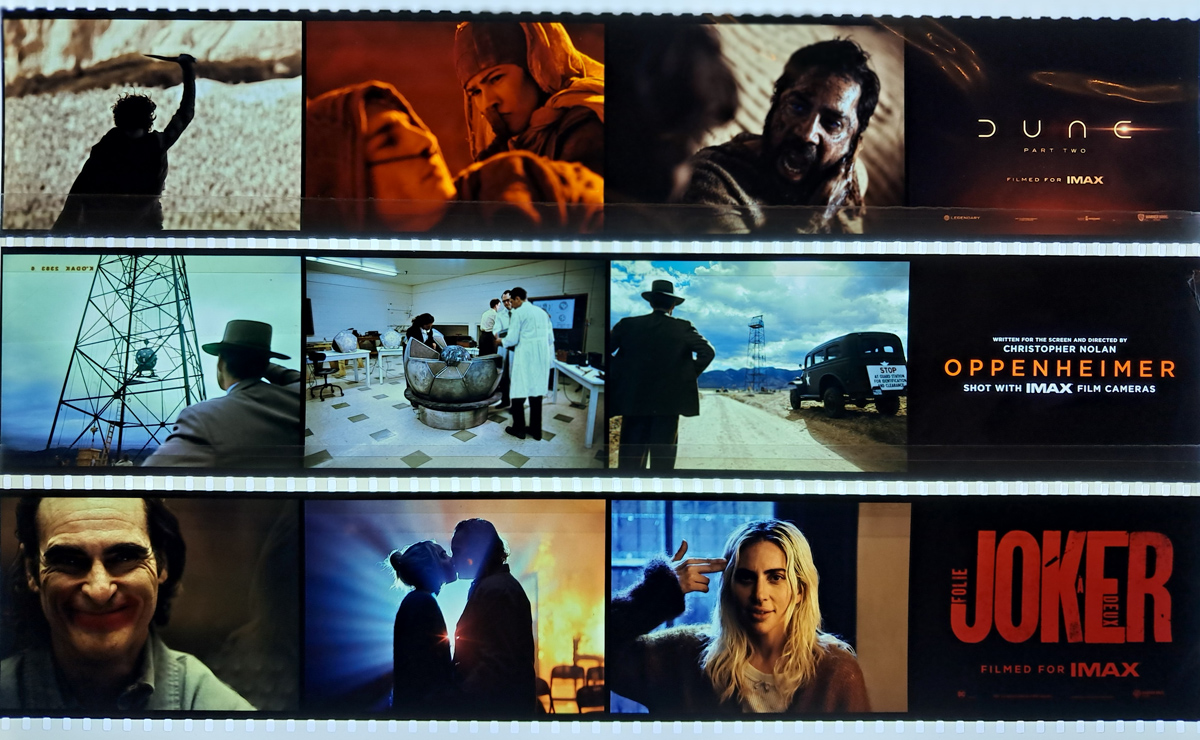
Nolan has been captivated by the IMAX format since childhood and has aspired to shoot an entire feature with IMAX Film Cameras for nearly as long. “As a kid, I went to the Museum of Science and Industry in Chicago and saw Omnimax films,” says Nolan, referring to a 360-degree presentation of IMAX films projected onto hemispherical screens in domed auditoriums. ”I would also go to the Great America theme park outside Chicago and see IMAX films. Every time I watched one of those films, it was the same excitement for me. I would also wonder: What if you did a fictional film that way? Not just a great documentary, like the incredible work directors like Toni Myers did about the space program. What if you made a Hollywood action film that way? And so, for me, it has been a long-held dream since I was about 16, to do an entire film in IMAX.”

Since The Dark Knight, Nolan has shot select sequences in his films using IMAX Film Cameras, and with van Hoytema, he has been ramping up the ambition and innovation each time. “We have always been guinea pigs for IMAX,” Nolan says. Van Hoytema shares Nolan’s passion for the format. “Anybody that has ever shot even a little test on IMAX understands straight away the power it has,” van Hoytema says. “It is a camera that does not lie; it has such beautiful depth and resolution. It is a masterpiece of organic image creation.”

The most significant obstacle in the way of shooting an entire movie with IMAX Film Cameras has been the disruptive noise they generate. Before The Odyssey, that noise prevented the filming of close-up dialogue scenes because the actors had to shout to be heard over the sound of the camera. (Matt Damon once famously compared the din to someone running “a blender in your face.”) In preparation for Nolan’s 2020 film Tenet, Nolan and van Hoytema, working with IMAX engineers, came close to creating an IMAX camera muffler dubbed “the blimp:” a large, heavy casing that covered the camera. Sadly, the camera was still too loud.

But as he was writing The Odyssey, Nolan realized he was developing the IMAX movie of his dreams, and so he nudged his friends at the company to start again on the blimp for its next-gen camera, which would become known as The Keighley—named for David Keighley, the late Chief Quality Officer at IMAX and his wife, Patricia, both long-time champions of the format. “I went to IMAX, without telling them what the film was,” Nolan says. “And I said, ‘I know you guys are building new cameras. If you can find a way to encase them so that I can record sound with them, we are going to commit to making the entire new film with IMAX cameras.’ And they stepped up to that.”

The result was nothing short of a game-changer. “We shot a test,” van Hoytema says, “and the moment we saw it projected with sound, it was evident that it could do something very beautiful and very special.”

Still, the filmmakers had concerns about shooting The Odyssey exclusively with their muzzled Keighleys, so much so that they entered production prepared to immediately make a switch to different cameras for certain scenes if necessary. When encased in the blimp, IMAX Film Cameras become quite heavy, almost 300 pounds, making them difficult to haul and position. They are also bulky (“a big black box, like a refrigerator,” van Hoytema says) and can present eyeline problems for actors on set. Moreover, IMAX Film Cameras can only carry mere minutes of film in their magazines because the stock is so large and thick; after three minutes of shooting, the camera needs to be reloaded.

None of this deterred Nolan or van Hoytema or The Odyssey’s cast and crew. Solutions were found. A team of six crew members were tasked with lugging the blimped-out camera wherever it needed to go. Nolan and van Hoytema’s team created a solution to eyeline complications by rigging a system of mirrors that allowed actors to see each other while performing.

A critical test came midway through production when Nolan shot a long, tender, dialogue-heavy scene with Matt Damon and Anne Hathaway on the Ithaca palace set, a crucial scene that sets up and charges the story’s emotional context. “Whether or not we could actually shoot the whole film in IMAX hinged a bit on the outcome of that scene,” van Hoytema says. “By this time, KEITH DAVIS, my focus puller, had learned how to reload the camera so quickly, it had become a discipline. Everybody would pause, maintain calm, and Keith, in his stealthy way, would reload, and before we’d know it, we were up and running again. It all worked. That was when we knew that we could do the whole film on IMAX, no back-up plan necessary. When we traveled abroad again, we didn’t even take the other cameras with us. We went all-in on IMAX.”

• The Odyssey used 2.1 million feet of film, longer than the distance from Toronto to New York. The production employed both traditional IMAX Film Cameras and the new IMAX Keighley Film Camera®.

• The carbon fiber components of the new IMAX Keighley Film Camera are the same as the ones used for Formula 1 race cars and high-performance supercars.
 
 
LIGHTING INNOVATION: PLAYING WITH “FIRE”

As Nolan and van Hoytema strategized how to shoot their first major sequence, the sacking of Troy, they decided to shoot it at night. This presented a challenge: How to properly light the vast set and thousands of extras for IMAX Film Cameras in a way that felt authentic to a period in which torches were used as the source of illumination?

“I really wanted to make Troy an arena that we could just step into it and shoot in every direction and everywhere we would look, it would look real and it would look authentic, not lit by film lights,” says van Hoytema. “I really wanted to light the whole film with fire. But that’s impractical, for any number of reasons, none more important than issues of safety. Still, we wanted to achieve the effect. How to create of a world lit with fire without using fire?”

To that end, van Hoytema and his team worked with an outside vendor to create what they dubbed “pyrahedrons” using triangle-shaped circuit boards studded with hexagon-shaped arrangements of LED cells that emitted light the color and movement of fire. “It started with making a small amount, but it became quite a big project,” van Hoytema says. “We had a whole assembly team making thousands and shipping them to us. We used hundreds for the Troy sequence alone, sprinkling them throughout the city set, producing exactly the quality of firelight we desired.”

AN “INTUITIVE” COLLABORATION AND JOURNEY’S END

Over the years, van Hoytema says, he and Nolan have become more intuitive and relaxed in their partnership, capable of coming to a set and easily identifying the shots they want to tell a story to their liking. The Odyssey required every bit of learning they have accumulated over years of making movies, both together and apart. “But more than an application of all learned techniques, it is a cumulation of confidence and comfort,” van Hoytema says. “Even though it is a big technical challenge, I don’t think I have ever felt more relaxed, in terms of relying on the intuition of how this movie should come to fruition.”

And as physically taxing as it was to put The Odyssey on film with a heavy, blimped-out, mirror-blinged “big black box” of a cutting-edge camera lugged across the planet and hiked into all sorts of remote locations and harsh conditions, van Hoytema says he wasn’t ready for the adventure to end. “I had a tremendous amount of fun on this movie,” van Hoytema says. “All the crazy things we tried out in this film somehow worked out. It was exhausting, but I take extreme pleasure in the rigor and the problem-solving. It was very sad when it was the final wrap. For me, the film went by like a flash of light. If it would have gone on for months more, I would have loved it.”

THE LOCATIONS AND PRODUCTION DESIGN

To create the world of The Odyssey, Christopher Nolan once again collaborated with production designer Ruth De Jong, who earned an Oscar® nomination for her work on Oppenheimer. Her other credits include Jordan Peele’s Us and Nope. She was the first person that Nolan and Emma Thomas recruited for The Odyssey after Nolan had completed his screenplay in the spring of 2024. Her initial response to the opportunity was a mix of awe and terror.

“I couldn’t possibly say no, even as it slightly terrified me,” De Jong says with a laugh. “The Odyssey isn’t history like Oppenheimer, which was daunting in its own way. But Oppenheimer was set in a relatively recent real-world time and place. The Odyssey is mythology. There are aspects of a historicity to it, but that history is incomplete, vague or disputed. It requires interpretation. So, there’s great challenge to it because you have to set rules to create within. It was intimidating at the outset, but Chris is the best leader and coach; he knows how to navigate ambitious tasks. It was just a matter of taking a deep breath and putting one foot in front of the other.”

During her early days on the project, De Jong delighted in watching others have the same reaction as she did to the script. “One of the best parts of the process was watching each new person who joined the production go into a room, read, and then come out with this look that said two things at once: ‘How am I going to do this?’ and ‘How can I possibly say no?’ But I was also there to say: ‘We can do this.’”


AESTHETIC AND RESEARCH

As always, Christopher Nolan was committed to making a fantastic cinematic world that felt as grounded as possible. “I wanted to bring my sensibility to the genre of Greek mythology, a type of cinematic storytelling that I really enjoy and that I think can have real power for an audience,” Nolan says. “A lot of that is about texture. And a lot of that, for me, is about using real-world solutions, getting out in nature, getting out on real locations, and using that to inform the reality. Extreme climates and landscapes were essential; I wanted to create a world where you really can imagine that you are on that boat with Odysseus, where you can understand a worldview that interpreted the conditions of nature as embodiments or expressions of stormy, mercurial gods. And part of the thrill of even doing the work was the creative process of figuring out how can we take incredible ideas and outlandish scenarios and make them real.”

Nolan and De Jong worked with LAUREN SANDOVAL (Oppenheimer, A Complete Unknown), a visual researcher who helped them delve into the culture of the Bronze Age. “It was very important to Chris to figure out exactly what we know about the era of the Trojan War,” producer Emma Thomas says. “What they discovered was that we don’t know very much and much of our understanding of the Bronze Age is based on intelligent speculation. Still, what they did learn was invaluable in creating a world that had a logic that we could tap into.”

Unearthing more concrete detail about the era would have made things easier, to be sure. “Our research was like trying to shine light into the darkness and seeing that there is not much but darkness there,” Nolan says. “That put a huge burden on the people working on the film to meet the challenge of creating a world that feels as complete as a contemporary movie, whether you’re talking about finding and building the boats, or designing costumes, sets or props. This world has to be built from research, extrapolation and informed speculation to be convincing, expressive and internally consistent.”

LOCATIONS AND LENGTH OF PRODUCTION

Nolan and De Jong spent months traveling and researching in their quest to find places where they could create the varied realms described in Homer’s poem—the beaches of doomed Troy, the cavern of the Cyclops, the underworld of Hades, and the island homes of Calypso, Circe, the Laestrygonians and Ithaca, not to mention the stormy seas between them all. Their criteria included a desire to avoid the familiar tropes formed by “sword and sandal” epics of earlier Hollywood history, many of which were shot in the deserts of Spain or took cues from Romantic art. Nolan and De Jong ultimately found what they were searching for in six countries: Morocco, Greece, Italy, Iceland, Scotland and the United States. What they could not accomplish on location they built and shot on California soundstages.

“Odysseus travels to places which, for the original audience of the poem, were completely unknown and outside of their experience,” Nolan says. “These places would have sounded fascinatingly exotic and strange. We wanted to capture that in the film, so we didn’t limit ourselves to a very tight Mediterranean perspective of where a historical Odysseus, had he existed, might actually have gone. We knew our story started and ended in the Mediterranean, but to bring to life the places in between we needed much different landscapes and environmental conditions. Harsh seas. Wind. Rain. Snow. You want all of it for the fantastical scope that Homer’s first readers would have had.”

Getting all of that for Nolan over the course of 91 shooting days across six months wasn’t easy, but Emma Thomas, who has produced every single one of his movies, has made a career of meeting audacious challenges. “Every movie we have ever made, there has always been one big scene that everyone spends most of the time talking about how they are going to achieve it,” Thomas says. “On this one, we had so many.” She laughs. “It really did feel as though we were making the most complex element of any other movie over and over and over again. Every location we went to had incredible, seemingly insurmountable, issues. But we always found a way.”

TROY

Production began on The Odyssey in February of 2025 in Morocco. The beaches of Essaouira on the Atlantic coast provided the discovery site of the Trojan Horse and the boat launch for Odysseus’s journey back to Ithaca. Aït Benhaddou, located near the Atlas Mountains, provided space and structures for De Jong to craft the massive, 360-degree set representing the fabled, doomed city of Troy. “We knew we wanted to build as much of the set as possible within an existing location,” De Jong says. “What we didn’t want to do was use digital effects to create set extensions.”

They started shooting with the fall of Troy. “We needed that to be on an absolutely colossal scale and as immersive as possible,” Nolan says. “Ruth and her team figured out how to build something into a real place, where we had enough existing architecture to ground it in reality. We also needed to safely burn down parts of it, so we had to build those parts in reasonable proximity to existing structures. It was an extraordinary logistical challenge.”

• The set of Troy covered more than 2.5 acres, or over 110,000 square feet, large enough to accommodate 2,000 extras and more than 60 structures. Those structures included the Temple of Athena, the largest building on the set, which measured 48 feet and 8 inches wide by 86 feet and 4 inches deep by 37 feet high. De Jong’s team also built the vast stone steps leading up to the plaza and temple by hand.

• The production also constructed working Gates of Troy, along with a perimeter wall featuring custom crenellations.

• Every element was designed to marry seamlessly with Aït Benhaddou and help achieve the grand scale of Troy in camera. The production also craned in 15 full-grown olive trees to bring greenery to the newly built portion of the set.

THE TROJAN HORSE

Nolan entered production with a strong vision for the Trojan Horse, as he had already given the matter much thought when he was briefly attached to direct the movie Troy in the early 2000s.

• Nolan’s adaptation accentuates Odysseus’s deception by making it less suspicious than the traditional horse on wheels. His Trojan Horse presents as an offering to the sea god Poseidon, left in the surf to be taken by the waves. “If you’re going to believe that the Trojans take this offering from the Greeks into their city, it has got to be a good trick,” Nolan says. “So, I had this idea that as the Trojans find it, the horse is sinking in the sand, battered by the waves. It’s risky; Odysseus doesn’t know if they’ll take the bait. But they haul it into their city from the beach as a trophy.”

• Multiple horses were built for use in different locations. Each was approximately 35 feet tall. “Big enough to stuff enough guys that can accomplish the mission at hand, but not crazy oversized, and, most importantly, no wheels,” Nolan says. “I wanted something that had to be dragged across the plains of Troy, something that was difficult for them to get into the city. That felt more credible to me.”

• The Trojan Horse used on the beach of Essaouira suffered much wear and tear over multiple takes, much to De Jong’s mounting anxiety. “The joke on set was that the horse should have been a cat, because it needed all nine lives to survive the abuse it took during all our testing and filming, during every drag across the dunes,” De Jong says. “It was getting ripped apart, and it was really hard to watch, but it made it to the end.” With the necessary repairs, Kirk and his team were able to give the horse several more lives for the remaining scenes ahead.

ITHACA

The island of Favignana near Sicily portrayed Ithaca, home to Penelope, Telemachus, and long-lost Odysseus. De Jong built structures in the rural countryside comprised of the town of Ithaca and the pig farm and humble abode of Odysseus’s loyal friend and swineherd, Eumaeus. But what sold Nolan and De Jong was a 15th century castle, the Castello di Santa Caterina, atop Monte Santa Caterina, a rugged hill rising 1,030 feet above sea level, with a panoramic, 360-degree view of the countryside and Mediterranean Sea. It also had no access roads; to get to the rustic fort, you had to hike to it. “Early in our scouting, Ruth remembered she’d been to Favignana 10 years earlier,” Nolan says. “We went there and saw that it was a deeply impractical location. But when we climbed up to the castle and saw the view, it just felt like Odysseus’ home. It felt like Ithaca. We looked at more practical, easier accessible locations in the months after that, but we never got Favignana out of our head. So, we committed to it.”

• The production gained permission from Italy’s Ministry of Culture to shoot at the castle and fabricate temporary additions to the exterior to suggest the scale needed for Odysseus’s palace.

• However, a request to build an access road was denied. Executive producer Thomas Hayslip built a funicular lift and assembled a small fleet of helicopters to haul equipment and supplies to the top of Castello di Santa Caterina. Anyone who wished to hop a ride was allowed to do so, space permitting. But most of the cast and crew, including Christopher Nolan and Emma Thomas, made the hike each day of the three-week shoot, a tough but rewarding commute that became a bonding ritual for all.

• Most of the scenes inside the palace were shot on a soundstage in Los Angeles. Replicating the architectural details and elements of the Bronze Age as well as leaning into the style and textures of the Castle at Santa Caterina, De Jong’s expansive set of many rooms included Penelope’s chambers and the megaron, a great hall that was the central feature of ancient Greek palaces. The structure was three stories tall and the length and width of a football field.

CYCLOPS CAVE, THE UNDERWORLD

A real-world cavern steeped in Greek myth was used to stage Odysseus’s encounter with the Cyclops: Nestor’s Cave, nestled in the foothills of the Peloponnese region of Greece. The space—65 x 52 feet, with a vaulted ceiling 95 feet high—has been used by humans since the neolithic period and has been linked to several Greek myths originating in the classical age, like one that says the fleet-footed god Hermes used it as a stash house to hide cattle stolen from his half-brother, the sun god Apollo.

• Scenes of Odysseus venturing into the underworld to seek counsel from the spirits were shot near the top of the world: Iceland. Nolan filmed in June, in the eerie light of the all-day midnight sun, in desolate terrain and windy, rainy conditions. “I knew early I wanted the landscape of Iceland to portray Hades,” Nolan says. “This journey north, further and further into the cold, couldn’t be further away from Odysseus’ home in Ithaca.”

THE SHIPS

In the film, Odysseus and his men travel exclusively by ship during their post-war journey. Nolan’s ambition was to capture the visceral experience of what sea travel in the Bronze Age, in all its beauty, sweat and terror, would have felt like to the men onboard. That meant finding ancient ships. And shooting on the ocean. Making that vision a reality fell to marine coordinator NEIL ANDREA, who had worked with Nolan on Dunkirk and Tenet, and whose distinguished film career includes Cast Away, The Pirates of the Caribbean films and the most recent two Mission: Impossible films.

“Our biggest hurdle in the beginning was figuring out where all these ships were going to come from,” Andrea says. “We had a similar obstacle on Dunkirk but not as difficult. For The Odyssey we were going to have to find them, or create them, ourselves.” The solution was to do both.

For Odysseus’s principal ship, Andrea, Nolan and production designer Ruth De Jong found the Draken, a full-scale longship built to ancient specifications and from period appropriate materials, in Stavanger, Norway. The hull and rigging of the Draken matched the research in terms of the type of ship from the Mycenaean era that Odysseus might have used, with only minor modifications needed from the art department. Most importantly, the Draken is capable of open ocean sailing (having crossed the Atlantic twice) and came with a full sailing crew eager to become part of the movie.

“Odysseus’s ship needed to be able to handle the open ocean with high seas and high winds and safely transport casts and crew in challenging conditions,” Andrea says. “The Draken gave us all that, but it was going to have to be sailed by half real crew, half cast.”

That meant the cast playing Odysseus’s crew learning to raise the sails and row. And not movie rowing. Real rowing. They quickly discovered that moving a ship on the ocean by sheer muscle is no pleasure cruise. “Rowing for hours on end is not fun; you quickly learn to appreciate the invention of the engine,” Andrea says, laughing.

But the cast found their rhythm and stamina, and throughout the prep, training and filming, cast and crew safety remained Andrea and Nolan’s paramount priority. “Not many people realize that one of the most dangerous things on these ships are the oars,” Andrea says. “As the ship is moving at speed, if you accidentally drop one of the large oars into the water, or mistime the swells, you can easily break ribs and in some cases be picked up and catapulted overboard.” Something Nolan decided to dramatize in the film.
The cast also had to learn how to raise the massive wooden yard and set sail, a complex and hazardous procedure. “Watching the cast learn how to row and sail, and to be able to go out on the open sea and shoot these actors in real situations, performing real operations, gave a sense of authenticity to these sequences,” Nolan says. “We see the challenges faced by Odysseus’s men, and we start to sympathize with their struggle. The harsh realities of their journey are an essential part of the story, and the commitment of these incredible performers was essential to making this work.”

Filming days on the water were a major commitment for everyone aboard, including the camera and sound crew who had to perform all of their usual complex tasks while on a real boat on a real ocean. The marine department had to find ways to help everyone do their jobs at sea while keeping everyone safe. “Once you’re on those boats,” Andrea says, “you don’t get off.”

The production shot on water almost everywhere they went, and every location, from Morocco to Italy, Greece, Iceland and Scotland, presented its own obstacles. “Our first water day in Greece, it was blowing sixty knots, no exaggeration,” Andrea says. “The locals looked at us like we are out of our minds. But we do it safely and slowly, and we get what we can. There were no idle days on this shoot. You are pushing every day. The speed and efficiency of the entire team was really remarkable.”

Moving north didn’t make things any easier. Iceland and Scotland both presented their challenges. “We are fighting the tides, fighting the weather, and any time you mix shoreline, boats, and surf of any size, it’s difficult,” Andrea says. Every vessel, every beach landing, every mile traveled offshore was driven by a commitment to authenticity, performing marine feats that, in many cases, had never been attempted before. By the end of production, the fleet had crossed thousands of miles, endured storms, surf, freezing temperatures, and some of the most demanding marine filming conditions ever attempted for a feature film. “That’s what makes Chris’ approach, and this film, so special,” Andrea says.

THE COSTUME DESIGN

Ellen Mirojnick, the celebrated, award-winning costume designer, whose work on Fatal Attraction, Basic Instinct and Wall Street has created iconic Hollywood looks and inspired mainstream fashion trends, earned her first Oscar® nomination in 2024 for Oppenheimer. Reuniting with Christopher Nolan for The Odyssey, Mirojnick was drawn to the challenge of expressing the themes of Nolan’s adaptation and creating unique representation of cinematic mythology.

“Costume design is world-building,” Mirojnick says. “With The Odyssey, you are not designing a period, you are authoring a mythology. It exists at the intersection of myth, history, psychology, and pure cinematic scale. Odysseus is not a clean hero. He is a survivor of the collapse of a civilization, and that influences everything visually. Similarly, the world after Troy is exhausted, haunted, salt-stained, and spiritually fractured; every costume, environment, weapon and silhouette should and can carry the feeling of a world trying to remember itself after catastrophe. Shifting the aesthetic through those layers, from a world still standing to a world coming apart, through the paces of a story with so many different scenarios, environments and textures, was creatively exhilarating.”

• The total number of costumes designed and produced for The Odyssey was 5,300.

• In Los Angeles, the costume department’s hub of operation, Mirojnick’s staff included a 175 person team of artists, including assistants, illustrators, sculptors, mold makers, fabricators, specialty costumers, cutters, drapers, leathermakers, breakdown artist painters, drapers and pattern makers, textile artists, fitters and set costumers dedicated exclusively to the development and production of the main cast wardrobe and armor.

• Mirojnick oversaw a 500+ person crew, working across Los Angeles, Morocco, Italy, Greece, Iceland, Scotland, Spain, England, New York and New Zealand.

AESTHETIC

“My design process was from the inside out,” Mirojnick says. “I began with the text, then moved through history, and ended in myth. We did an extraordinary amount of period exploration. It was important to ground the world in a new mythic reality, using silhouette logic, social hierarchy through dress, and warfare practicality, thus creating a subconscious credibility. Fusing archaeological realism with mythic imagery to create a consistent and comprehensible world.”

This perspective bled into a grounded yet richly thematic character-driven approach to costuming. “We wanted the costumes to feel lived-in, intimate and emotionally revealing,” Mirojnick says. “The goal was always to make the audience feel close to the characters, to understand them through texture, silhouette, wear, restraint and evolution. What I found most compelling overall was the balance between intimacy and magnitude. The costumes had to support that accessibility while still carrying a sense of scale and cinematic beauty. The goal was to create a world where the audience could feel the humanity inside every character and every detail.”

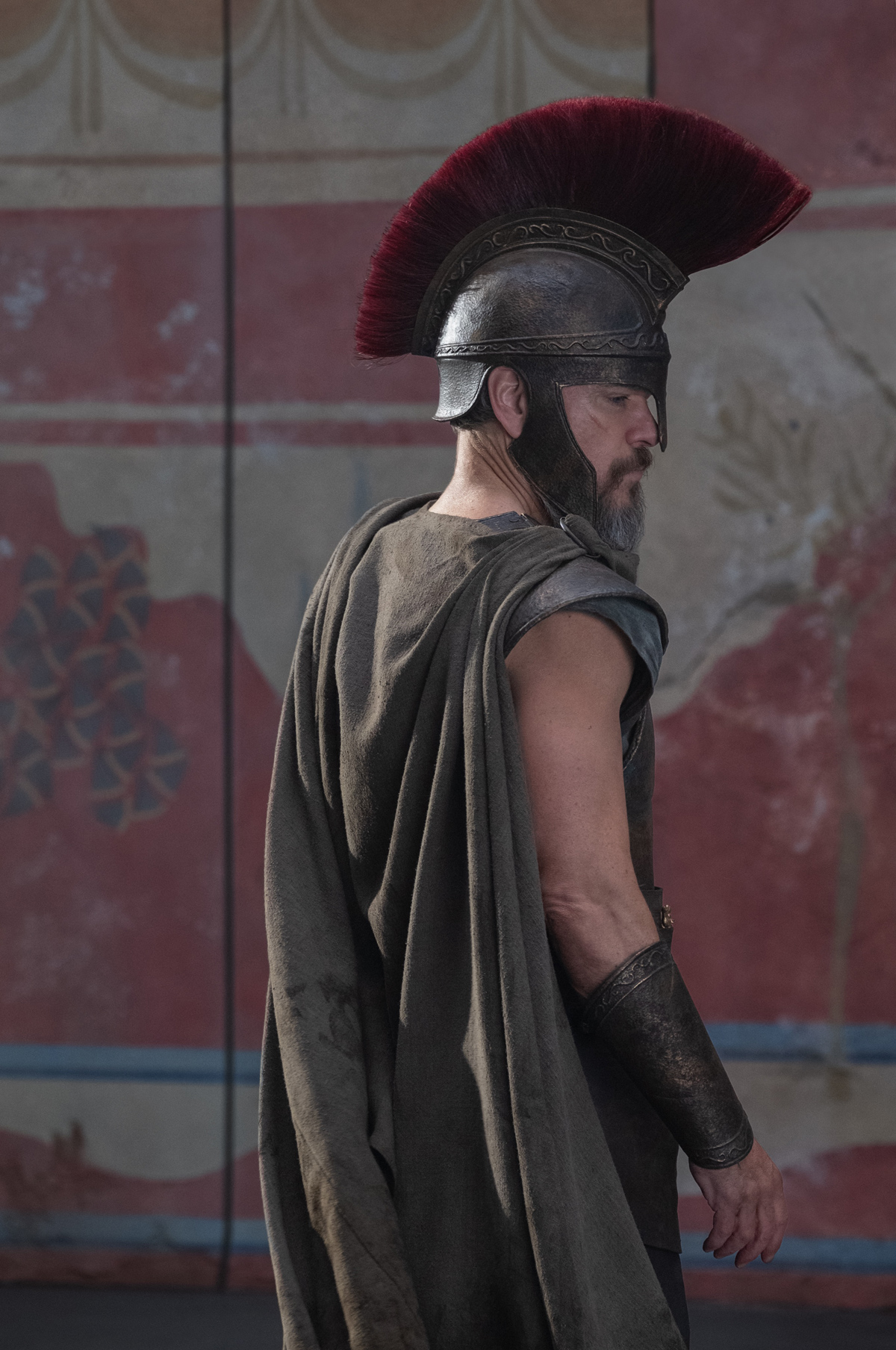
Mirojnick took the same approach to the defining material of Odysseus’s age: Bronze. “Often in movies, bronze is gold and gleaming,” Mirojnick says. ”Real bronze is dark, heavy, oxidized, dented, alive with its own history. We wanted armor that looked like it had been made by someone, struck by someone, worn by someone that had absorbed weather and violence and the body underneath it.”

The most difficult challenge? “Maintaining tonal coherence while moving through radically different mythic environments,” says Mirojnick. “The Odyssey is war epic, survival tale, haunted voyage, palace politics, divine encounter, psychological homecoming. The costumes have to evolve with the mythology without ever losing the feeling that these are real people living inside a collapsing world.”

RESEARCH

“The research process began archaeologically first, mythologically second,” Mirojnick says. “Our foundational sources came from Mycenaean Greece and late Bronze Age Mediterranean cultures. We studied surviving frescoes, burial artifacts, armor reconstructions, textile fragments, jewelry, weapon construction, dyes and weaving methods, climate effects on materials, and maritime cultures. Attention went into understanding what people wore before Classical Greece existed. For example, layered linen armor, bronze-scale protection, wrapped garments rather than sculpted drapery, leather reinforcement, asymmetrical fastening systems, and practical sea-travel clothing.”

Mirojnick says she and her team also researched how clothing and armor aged and degraded over time when routinely subjected to extreme weather and maritime conditions. “Because Odysseus is traveling for years, materiality becomes part of the storytelling,” Mirojnick says. “We spent time studying how fabrics collapse, how garments layer under movement, how surfaces age, how metals react to light, what saltwater does to bronze, how linen collapses over years, how dyes fade in Mediterranean sun, and how armor repairs accumulate during war.”

Then there was the mythic research: Homeric symbolism, ancient depictions of gods, ritual dress, funerary practices, sacred animals, dream imagery, underworld iconography, and ideas of kingship and heroism. “The interesting challenge was deciding where mythology entered the visual language,” Mirojnick says. “It had to feel authentic and credible, culturally and psychologically, not show up as fantasy decoration.”

“There are certain qualities in the power of dress that became very inspiring in terms of how fabric could hold movement, gravity and quiet command without feeling overly decorative,” Mirojnick says. “That sense of restraint and control was something we discussed often, especially for characters where emotional strength needed to feel internal rather than performative.”


DESIGNING FOR IMAX FILM CAMERAS

“Knowing that we would be making costumes that would be photographed by IMAX Film Cameras profoundly influenced our work,” Mirojnick says. “IMAX is an unforgiving format, and I mean that as the highest compliment. It shows you everything. Every weave, every fiber, every dye lot, every stitch, every place where the work is real and every place where it is not. Shooting on IMAX was not just a technical context for the design. It was, in a way, the design’s accountability partner.”

The most immediate effect that IMAX had on Mirojnick was her choice of materials. “Anything synthetic announces itself instantly on IMAX,” Mirojnick says. “A polyester pretending to be wool, a poly-blend pretending to be linen, a modern weave pretending to be a hand-loomed one. The camera reads the truth of the fiber before it reads anything else. The commitment to natural materials, hand-loomed cloth and natural dyes was not a stylistic preference. It was a structural necessity.”

Nowhere did this matter more than with the bronze armor. “IMAX is merciless about metal,” Mirojnick says. “Movie-bronze falls apart instantly on this format. Real bronze, aged bronze, has a depth to it the camera understands. The dark patina, the oxidization, the dents and scratches and repairs, the way the surface has absorbed sweat and salt and weather and the body underneath it. We aged every piece of armor by hand, with chemical patinas, real abrasion, and real impact. We were not trying to make armor look old. We were trying to make it look used, as if it was pulled from the earth.”

The same logic applied to cloth. “You have to actually live the wear into the garment, with months of sun, salt, oil, abrasion and repair,” Mirojnick says. “Every crease has to have a reason. Every fade has to have a story.”

THE FALL OF TROY

A singular challenge for Mirojnick and her team was working the days in which Nolan filmed the attack on Troy with thousands of extras. “Those days asked everything of you, and they began long before sunrise, around 3 AM or 4 AM,” Mirojnick says. ”By the time you arrived, the costume tents were already alive. There were rows and rows of racks stretching endlessly for background performers, stunt teams, specialty armor, weapons support, fittings, continuity stations, aging stations. Every section functioning simultaneously. It felt military in its organization. Hundreds of people moving at once, but everything needing to remain incredibly precise. This is where costume design stops being theoretical and becomes an enormous act of live orchestration. The scale alone becomes staggering. Hundreds of background performers, stunt teams, principal cast, armor continuity, blood continuity, mud continuity, weather shifts, fire effects, smoke, multiple stages of battle damage. Every single layer has to remain coherent on camera while still feeling spontaneous and alive.”

Mirojnick says a single battle day could involve tracking hundreds of costume pieces, multiple duplicate costumes reflecting different stages of damage, fast resets between takes, taking pictures of every character in costume before every take for continuity, and dressing teams working simultaneously in massive holding areas located in different areas of a sprawling set.

“What I remember most is how physical the work became,” Mirojnick says. “Dust covering everything almost immediately. Constant repairs between takes. Refastening armor. Re-layering costumes after action work. Watching fabrics and materials evolve naturally through the day because of heat, sweat, movement, and terrain. What was exciting was seeing the scale become human. In the middle of hundreds of performers and massive setups, suddenly you would notice very small details: the way a damaged piece of armor sat on someone after hours of action, or the way dust transformed the color and texture of a fabric in-camera. Those details grounded the spectacle emotionally, made the world feel inhabited rather than staged, and rendered each character with striking, meaningful specificity. Even within huge battle compositions, you are constantly thinking about the people. Often the most powerful images are not the grandest ones. They are the small details inside the scale where myth suddenly becomes human.”

THE MAKE-UP AND HAIR DESIGN

One of Christopher Nolan’s frequent collaborators, make-up designer Luisa Abel has worked with the director on Interstellar, Dunkirk, Tenet, and Oppenheimer, earning an Oscar® nomination for the latter. New to Nolan’s team is hair designer Gloria Casny, who received an Oscar® nomination in 2014 for The Lone Ranger. She also worked on Twisters, The Fabelmans, and two films with Matt Damon, The Informant and Ford v Ferrari, among many other credits.

• Abel had to staff a department that could handle many different make-up disciplines: beauty, beard work, prosthetics, aging makeup and tattoo coverage. The traveling team, composed of artists from the United States, the United Kingdom and Italy, varied in size from country to country depending on scale and need. They were further assisted in Iceland and Morocco by local professionals. In total, approximately 90 makeup artists contributed to sculpting, mold-making, beard work, and prosthetic application throughout the film. Abel was further supported by two prosthetic labs, one on the U.S. and one in the U.K.

• Casny was assisted by hair stylists from the United States and Italy. They were further aided by local artists in each country where The Odyssey filmed.

AESTHETIC

• “Our first challenge was to ground mythology,” Abel says. “It was a massive undertaking. Each sequence of the film had a distinctly different genre tone and visual identity that needed to feel lived-in and credible. At the same time, because modern products and grooming standards obviously didn’t exist during the Bronze Age, it was important to research reference that would feel authentic and era-appropriate while still achieving the film’s unique mythic aesthetic. Many of the products we used were custom-made specifically to create a more natural and historically grounded look, helping the world feel immersive and authentic.”

• As for hair, Nolan gave Casny clear direction: “No wigs,” she recalls with a laugh. “Most current hair trends don’t normally translate to period looks. But, after doing a lot of research into the Bronze Age, which is vague at best, we learned that there were actually barbers during that era of Greece, and for men, a short, normally layered look could work. For the women, the hair was normally very long, unless they cut it for a mourning period, so I did have to use long wigs and pieces for the background women with shorter hair. But Nolan’s basic direction was ‘timeless,’ which worked with our main cast.”
 
 
RESEARCH AND PREPARATION

• Both Abel and Casny looked to images painted on pottery, stonework and other artifacts from the period for inspiration and reference.
• “Almost every actor was asked to do some kind of preparation prior to shooting sometimes requiring weeks or month of commitment,” Abel says. “That started with fittings and design consultations so we could establish each character’s specific look well in advance. Then there were the beards. For many, that meant growing, shaping, or adjusting beard length.” All the actors were told to grow their hair before filming, so Casny and her team could trim or style as needed.
• “For hair, the biggest problem was wind and rain,” Casny says. “Lots and lots of wind and rain. I was ultimately grateful about the ‘no wigs’ mandate.”

DESIGNING FOR IMAX

“Shooting with IMAX Film Cameras absolutely affects the way we approach makeup,” Abel says. “The level of clarity and detail those camera capture means that every aspect of the work is under far greater scrutiny. Precision becomes incredibly important. A large part of our process involved working closely with cinematographer Hoyte van Hoytema on lighting tests so we could continually adjust colors, textures, and makeup applications to ensure that everything was being translated correctly on camera. In tight close-ups, there is no room for error. Because everything was being done practically rather than digitally enhanced, it pushed us creatively and technically every single day.”

THE CREATION OF THE CYCLOPS

Perhaps no single cinematic effect in The Odyssey sums up Christopher Nolan’s approach to making the film than the creation of the Cyclops, a hulking giant with one eye who herds sheep and dwells in a massive cave. Odysseus and his crew encounter the Cyclops early on their voyage, at a moment when they need food and supplies, and they take him to be a crude monster. Their abuse of the Law of Zeus, the principle of hospitality that informed the mores of ancient Greek culture (an early version of “treat others as you want to be treated”), elicits a monstrous response from him.

DEVELOPMENT AND MAKE-UP TESTS

Nolan’s strategy for bringing the Cyclops to life in a unique and credible fashion required a collaboration involving nearly every department. But the soul of the character was provided by Bill Irwin, the Tony-winning actor, choreographer, comedian and clown. He previously worked with Nolan on Interstellar in a similar capacity by helping create the blocky, modular robots TARS and CASE.
“The Cyclops, for me, was the same creative challenge as looking at the Batmobile in Batman Begins,” Nolan says. “How can we take something that seems so fantastic and make you believe in it? The advantage I had going into The Odyssey was that I now have a lot of experience with different types of techniques of how to put things on film, whether you’re talking about the use of visual effects, practical effects, stunts, real locations, building sets, and many more. We needed to use all of it for The Odyssey, and in particular, for the Cyclops. Every trick in the book.”


THE MUSIC

The Odyssey is Christopher Nolan’s third film featuring a score by Ludwig Göransson after Tenet and Oppenheimer, which earned the composer an Academy Award®. Göransson has also won Oscars® for Black Panther and Sinners and he is the recipient of six Grammys, including Song of The Year and Record of the Year in 2019 for “This Is America,” performed by Childish Gambino.

Nolan and Göransson began discussing the music for The Odyssey during pre-production on the film. “Talking to Ludwig, I asked, ‘What can we do with instrumentation that’s related to the ancient world—the aulos, the lyre—but with a modern, fresh approach to how we use them,’” Nolan says. “And Ludwig, as he does, has created an entire unique grammar, a unique set of sounds drawn from both antiquity and contemporary sources, but using the instrumentation of the ancient world. Some of the vocal stylings of the ancient world, some of the ways he’s using voices is incredible. He went all around the world finding sounds and putting them together and making them wholly his own.”

Nolan suggested a Trojan alarm system made of large bronze sheets that the people in Troy would have sounded during the siege on their city. “The growing cacophony would transform into a unified musical statement, ultimately evolving into Odysseus’s defining motif,” Göransson says. “Chris described it as a lament, which had to contain three notes that would recur throughout the movie.”
The three notes would be a musical signature to echo the sound of Odysseus plucking the string on his legendary bow. “Wanting a unique sound and melody that would grab the audience’s attention and emotions, Chris suggested we use the plucking of a lyre to emulate a bowstring,” Göransson says. (The lyre heard in the film’s score would ultimately be played by ROSA FRAGORAPTI, an archaemusicologist specializing in the study and performance of ancient instruments.)

Göransson began his writing process by composing songs with instruments he could perform himself, using guitar, harp, synthesizers, and 35 different gongs that he rented. “I was especially drawn to the sound of wind gongs, flat bronze discs with little fundamental pitch, heavy tuned overtones and long sustains,” Göransson says. “The challenge of writing music using gongs was exciting, and I created a unique notation system with detailed drawings of exactly where to hit the gong, with exact velocity.”
As Nolan began principal photography, Göransson sent him a 42-minute demo of how the score was evolving and continued to do so throughout production. “It was clear Ludwig was embarking on his own extraordinary musical odyssey,” Nolan says. Göransson watched new cuts of the film weekly with Nolan, Thomas and editor Jennifer Lame, and the score developed over time. By the time filming ended, Göransson had spent nine months producing nearly four hours of music.


THE DEDICATION: DAVID KEIGHLEY

The Odyssey is dedicated to the memory of filmmaker and movie executive David Keighley, the late Chief Quality Officer at IMAX and a long-time champion of the format.

Keighley and his wife, Patricia, were inspired to get into the movie business after seeing the first documentary ever shot entirely full-frame in IMAX, the 1971 short film North of Superior. In 1972, they started David Keighley Productions (later DKP 70MM) specializing in large-format filmmaking and post-production services.

In 1988, after IMAX acquired DKP 70MM, the Keighleys joined the company in executive roles. During his 37 years at IMAX, Keighley helped facilitate the company’s transformation from a maker of short films to a major producer of documentary features and he played a key role in further enhancing IMAX technology and expanding the premium theatrical experience to include Hollywood features. Keighley also helped oversee development of the new model of IMAX Film Camera used for The Odyssey, which is marked by improved functionality, lighter weight, and reduced noise. It has been named “The Keighley” in honor of both David and Patricia.

• Go to IMAX to develop new fleet of next generation IMAX film cameras

Keighley also forged relationships with Hollywood filmmakers who were equally captivated by the sharper, more vivid quality of IMAX 70mm films, which currently deliver nearly 10 times the resolution of conventional 35mm film and three times the resolution of standard 65mm film cameras. David and Patricia Keighley first met Christopher Nolan and Emma Thomas in 2004 while working together on making prints of Batman Begins for IMAX theaters and they became friends.

With cinematographer Hoyte van Hoytema, Nolan’s longstanding collaboration with IMAX has helped drive some of the company's most significant technical innovations, including The Keighley, pushing the boundaries of what is possible in filmmaking and exhibition. Nolan shot The Odyssey using only IMAX Film Cameras, and David Keighley, in his capacity as Chief Quality Officer, supervised the processing and printing of daily footage. Keighley finished his work on The Odyssey three weeks prior to his death on August 28, 2025, at the age of 77. He is survived by Patricia, their three children, and two grandchildren. “Our entire industry owes David a massive debt,” Nolan says. “I miss him as a collaborator and as a friend.”


• Go to
News about "The Odyssey" By Sir Christopher Nolan
 
Go: back - top - back issues - news index
Updated 17-07-26